
In cold-chamber high-pressure die casting (HPDC), piston selection is a critical decision for production stability. The piston system influences the heat extraction from the biscuit and injection gate region, the movement of the piston through the shot sleeve, the stability of the piston-sleeve clearance, and the service life of both components. For engineers evaluating and comparing piston systems, the central question is: Which configuration keeps the casting process stable over repeated cycles?
To answer this question, we need to look not only at material data but also at piston architecture, cooling design, sleeve condition, lubrication, vacuum requirements, and maintenance behavior. A piston system that performs well in isolation may still create problems if it expands unpredictably, receives insufficient cooling, or operates in a worn or thermally unstable shot sleeve.
This article provides a practical evaluation framework for High-pressure Die Casting piston systems, supported by data from numerical simulations and real-world production.
For a structured approach to choosing the right alloy and configuration for your HPDC components,
see our Material Selection Guide for High Pressure Die Casting Components.

The Piston’s Job in Cold-Chamber HPDC
The piston’s primary role is to push molten aluminum or magnesium alloys through the shot sleeve and into the die. In production, its function is broader. The piston contributes to heat extraction from the biscuit and the injection gate region, where rapid solidification supports shorter cycle times and process stability.
This is why copper alloys are used in cold-chamber HPDC piston systems. Their value comes from the ability to extract heat quickly from the critical hot zone. Heat transfer can be expressed as:
Q = ΔT × λ × A / s
Where Q is heat flow, ΔT is the temperature difference, λ is thermal conductivity, A is the heat-transfer area, and s is the front wall thickness or distance for heat conduction. A recent investigation on plungers (pistons) and shot sleeves by Jürgen Barz, Head of Product Management at AMPCO METAL, explains that the main influenceable variable in piston material selection is the thermal conductivity of the selected material. The study links the use of copper alloys in pistons to cycle-time reduction and improved shot-sleeve service life through faster heat extraction from the gate area and biscuit.
This gives engineers a useful starting point. A piston system should first be evaluated by its ability to transfer heat from the biscuit region into the cooling circuit. High conductivity creates value when the piston architecture and cooling circuit provide a reliable path for that heat to leave the piston.
1. Evaluate Piston Systems by Behavior
A piston specification can identify the alloy, geometry, and dimensions. However, those values do not fully describe the system’s behavior during production. Under repeated thermal cycling, the piston and shot sleeve both deform. The resulting clearance affects wear, melt leakage past the piston (shot through), vacuum stability, and process repeatability.
For supplier evaluation, engineers should compare piston systems across eight criteria:
- Heat extraction: How effectively heat is removed from the biscuit and injection gate region
- Cooling path: Whether the cooling channel geometry, water-tube position, flow rate, and inlet temperature support heat removal
- Temperature distribution: Whether the piston face develops large thermal gradients during the cycle
- Thermal deformation: How much the piston front edge expands during dosing, injection, and cooling
- Piston-sleeve clearance: Whether the clearance remains controlled under thermal load
- Shot sleeve behavior: How sleeve deformation affects piston movement and contact
- Serviceability: How quickly the piston head, ring, or adapter can be inspected and replaced
- Vacuum casting requirements: Whether the piston-sleeve interface maintains sufficient sealing for the required vacuum level
A piston system should, therefore, be selected according to the behavior it produces in the machine. Our material selection guide uses a similar logic by framing HPDC component selection around thermal, mechanical, wear, air evacuation, and maintenance constraints.
2. Assess the Architecture: Heat Path, Load Path, and Cooling Path
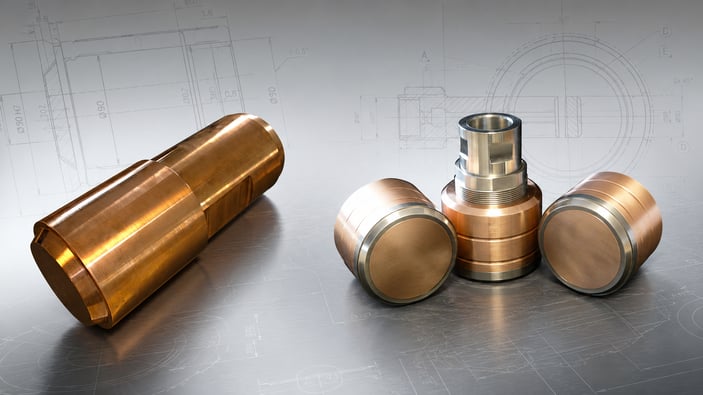
The AMPCO piston-adapter system separates the thermal and mechanical functions of the assembly. The copper-alloy piston head operates in the hot zone, where heat extraction and sleeve contact matter most. The steel adapter provides the structural connection to the piston rod and absorbs injection pressure. According to the system design, the thread ring remains free of injection pressure, allowing the piston head to be replaced more quickly.
This design approach matters for both performance and cost. The copper alloy is concentrated where heat extraction is needed, while the steel adapter provides mechanical stability and connection to the piston rod. As a result, the system avoids unnecessary copper volume while preserving the thermal function of the piston head.
Adapter design also depends on customer-specific requirements, in order to use the existing piston-rod. Three key design inputs must be checked in advance:
- Total overall length of the piston in use including adapter and piston rod
- Drill-hole diameters for water cooling
- The connecting thread to the piston rod
The system must fit the machine, the piston rod, the cooling arrangement, and the production target.
3. Use Simulation Data to Evaluate Thermal Deformation
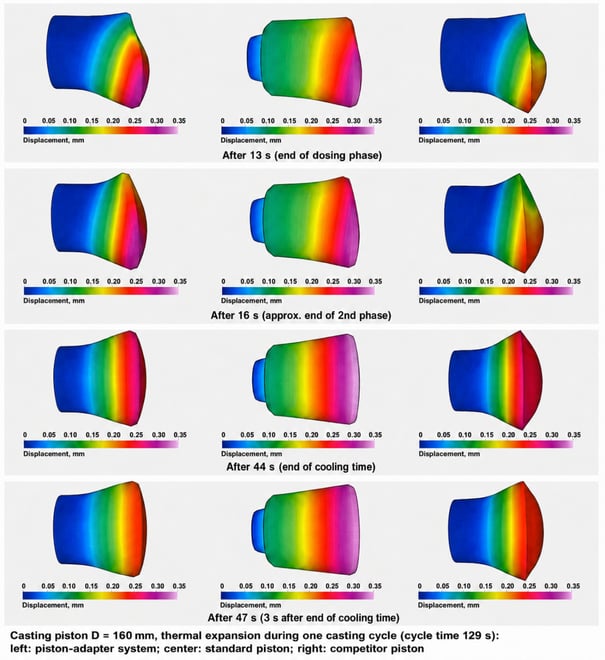
Numerical simulation is useful because piston deformation is difficult to evaluate from material properties alone. Barz’s investigation studied the temperature distribution and thermally induced deformation of pistons and shot sleeves during a casting cycle. The study examined piston design, diameter, chamber filling level, sleeve temperature control, and machine platen or die-frame temperature. Its objective was to improve piston-sleeve interaction and extend service life.
Different piston concepts were studied under defined process conditions, comparing AMPCO METAL designs to competitor pistons. The findings show why piston evaluation should include thermal behavior and deformation, especially near the piston face and front edge.
|
Simulation Finding |
Engineering Meaning |
|
The piston-adapter system reached cyclic thermal equilibrium after one casting cycle. Other pistons required two to three cycles. |
Faster thermal stabilization supports predictable operating behavior. |
|
Temperature variation at the piston face was approximately 1–2 K in the piston-adapter system. |
More uniform face temperature supports stable deformation behavior. |
|
Standard pistons showed approximately 5–10 K variation. |
Higher variation can contribute to less uniform expansion. |
|
The competitor piston showed a variation of approximately 25 K in the steel base body. |
Low thermal conductivity in the base body can create larger temperature gradients. |
|
Standard and competitor pistons showed front-edge expansion values more than 0.2 mm higher (measured relative to piston diameter) than the piston-adapter system. |
Front-edge expansion directly affects clearance, contact pressure, wear, leakage risk, and vacuum stability. |
4. Include the Shot Sleeve in the Evaluation
The shot sleeve should be treated as part of the piston system. During dosing, molten metal heats the lower part of the sleeve more strongly than the upper part. This uneven thermal loading can change the sleeve from a nominally cylindrical bore into an operating shape with ovalization and bending, also known as the “banana effect.” In larger sleeves, this deformation becomes more relevant because small radius changes can significantly alter piston-sleeve clearance.
Barz’s investigation found that the sleeve radius in the installation area, especially in the biscuit, can become smaller than in the filling-opening area. The study also states that this behavior depends strongly on the temperature of the machine platen and die frame. Low temperature in this region can force radial expansion inward, reducing the internal radius during operation. This has a direct and significant influence on piston design.
Engineers should check:
- Sleeve condition
- Sleeve temperature behavior
- Filling level
- Lubrication practice
- The thermal conditions around the sleeve installation area
AMPCO METAL experts recommend considering shot sleeve thermo-regulation from around 100 mm diameter upward, as the ovalization and banana effect become more significant with larger shot sleeves.
5. Validate Thermal Performance in Production
While simulation data helps engineers understand the mechanism, production comparison data shows how those mechanisms appear in operation.
In an AMPCO METAL study, a practical comparison between an AMPCO piston-adapter system and a competitor piston involved a 4-cylinder motor block produced on two casting cells in parallel, using the same casting cycle and piston cooling conditions. Piston cooling was 20 L/min, with 25°C inlet flow temperature. The results are shown in the table below.
|
Parameter |
AMPCO piston-adapter system |
Competitor piston |
|
Outlet flow temperature |
40°C |
32°C |
|
Biscuit temperature |
320°C |
420°C |
|
Vacuum value |
Reduced by 30 mbar with optimized outer diameter |
Baseline |
Under the same flow rate and inlet temperature, a higher outlet water temperature indicates that more heat is being carried away through the cooling circuit. The lower biscuit temperature points to improved heat extraction at the critical region. And the vacuum improvement shows that piston diameter and piston-sleeve clearance can influence system-level vacuum performance positively.
6. Evaluate Cooling as a Hard Constraint
Thermal conductivity cannot compensate for poor cooling design. The heat path is only complete when heat moves from the biscuit into the piston head, through the piston architecture, and into a cooling circuit with sufficient flow and correct tube positioning.
That is why water cooling is important for all piston-adapter system types, including:
- Standard piston-adapter system
- Piston-adapter system with a steel wear-ring
- Piston-adapter system with a split steel wear-ring
The water-tube position and tube length must be precise to achieve the possible performance in dissipating heat from the biscuit and injection gate. Recommended water flow ranges are provided in the table below by piston diameter.
|
Piston diameter |
Recommended water flow |
|
50–80 mm |
12–16 L/min |
|
80–110 mm |
16–20 L/min |
|
110–130 mm |
20–25 L/min |
|
130–150 mm |
25–35 L/min |
|
150–170 mm |
35–45 L/min |
|
170–210 mm |
45–55 L/min |
These values give engineers a practical validation point. We know from experience that in practice, the flow rate is mostly less than the recommended one. If the piston overheats, the reason may not be the alloy. The cooling channel geometry, water-tube position, flow rate, inlet temperature, and outlet temperature should be checked before the piston concept is judged.
7. Assess Service-Life Configurations
In addition to all the aspects mentioned above, service life is just as important. AMPCO piston systems can be configured as standard piston-adapter systems or as systems with a wear ring or split ring. The correct configuration depends on diameter, sleeve condition, service-life target, vacuum requirements, lubrication practice, and maintenance discipline.
- The standard piston-adapter system is usually recommended from Ø 50 to 210 mm.
- All versions with wear ring or split ring are recommended from Ø 70 to 210 mm.
The solid wear ring can increase lifetime by 2.5x to 3x compared to no-ring systems. However, ring-based systems add a maintenance and operating requirement. For example, split-ring systems require controlled lubrication at the ring interface. When liquid lubricant is used, it should be applied to the front ring. Where this is not practical, graphite beads can be used as an alternative lubricant delivery method. The shot sleeve must also have chamfers on both sides so the expandable split ring can re-enter the sleeve without damaging the ring or sleeve edge.
This makes service-life evaluation a system question. A ring-based piston can improve lifetime under suitable conditions, and its performance depends on sleeve preparation, lubrication placement, inspection, and replacement practice.
Practical Checklist for Selecting
an HPDC Piston System
Before choosing a piston system, engineers should collect the inputs that define the operating window. They make it possible to evaluate what the limitation is and with what piston system to approach it.
- Piston diameter: Defines system size, cooling requirement, and ring-option relevance
- Existing piston concept: Identifies whether the issue may be material, geometry, cooling, or configuration
- Total system length: Needed to design the piston-adapter system
- Piston rod connection: Determines adapter interface and installation compatibility
- Cooling drill-hole diameters: Defines the available flow path
- Cooling water flow and inlet temperature: Confirms whether heat extraction can translate into real cooling performance
- Outlet water temperature: Indicates how much heat is removed through the system
- Biscuit temperature: Validates heat extraction at the critical region
- Shot sleeve condition: Worn or deformed sleeves can undermine piston performance
- Sleeve temperature control: Influences thermal deformation and clearance stability
- Filling level: Affects sleeve heating pattern and ovalization
- Vacuum casting requirements: Makes clearance and leakage control more critical
- Lubrication practice: Affects wear, ring performance, and sleeve service life
- Dominant failure mode: Guides the selection of material and configuration
- Cost-per-shot target: Helps compare full copper, piston-adapter, wear-ring, and split-ring systems
Final Thoughts
The right HPDC piston system is the one that keeps the operating window stable under thermal cycling, high mechanical load, sliding contact, and repeated production cycles.
For engineers comparing piston systems, the decision should be based on measurable behavior, including heat extraction, cooling performance, deformation, sleeve interaction, clearance stability, vacuum relevance, and service life.
AMPCO METAL’s piston-adapter systems are designed around this system-level requirement. The copper-alloy piston head supports heat extraction in the hot zone. The steel adapter provides load transfer. Ring-based configurations support extended service life where the operating conditions justify them. Cooling and sleeve conditions remain part of the selection process.
Get in touch with our technical experts to evaluate piston diameter, cooling conditions, shot sleeve behavior, vacuum requirements, and service-life targets for your cold-chamber HPDC piston system.
