
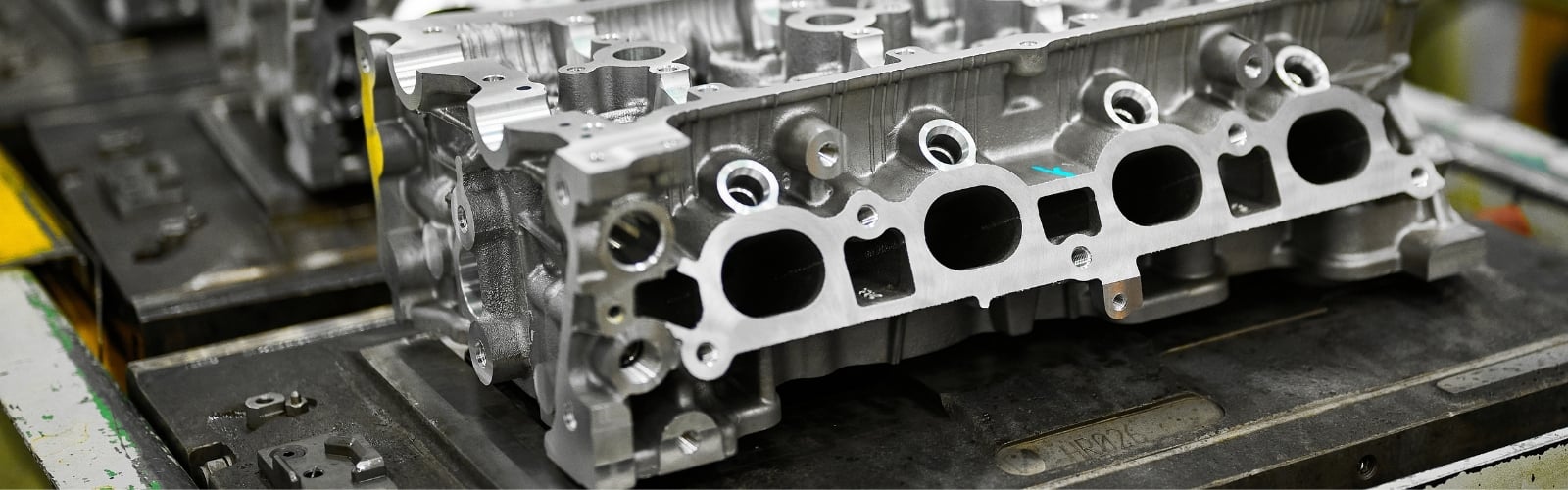
High-pressure die casting cycle time is largely decided by shot timing: phase 1 and phase 2 piston speed, the switch-over point, resulting gate velocity, then filling time and holding time that lock in quality.
Cycle Time Is Built into the Shot Profile
In HPDC, cycle time is sometimes discussed as a “cooling problem,” but in day-to-day process work it is usually won or lost by the design of the die casting die and the shot profile. That’s because the die design and injection sequence set the initial conditions for everything that follows. How stable the cavity fills depends on how much air is trapped and how much of the holding phase actually supports the casting as it transitions into solidification.
From a practical standpoint, high-pressure die casting cycle time is tied to repeatability. If piston motion, switch-over, and gate velocity vary shot to shot, operators end up compensating with longer holds or conservative settings that protect quality but slow production.
The goal of this article is to explain how time and speed variables link together to increase an understanding of where cycle time is genuinely constrained and where it’s being extended to compensate for instability.
Phase 1 vs Phase 2 Piston Speed and Why Switch-Over Timing Matters
In all HPDC setups, piston motion is split into two functional phases because the goals are different before and during cavity fill. The first phase is used to move metal through the shot sleeve in a controlled way, so the injection system starts from a repeatable condition. The second phase is the high-speed portion that has to fill the cavity fast enough to avoid premature freezing, especially in thin sections and long flow paths.
The switch-over between phase 1 and phase 2 is one of the most sensitive timing points in the shot. If it happens too early, the melt can become more turbulent than necessary, increasing air entrapment by which the quality of the cast suffers. If it happens too late, the fill time increases and the process becomes more temperature-sensitive, raising the risk of an incomplete fill. That’s why operators treat switch-over as a stability setting, not just a speed setting. A consistent switch-over point is often what separates a fast cycle that holds quality from a fast cycle that produces unpredictable scrap.
.jpg?width=1200&height=800&name=Blog%20images%201200x800%20(15).jpg)
Furnace used for melting aluminum to be used in HPDC
Gate Velocity From Piston Speed and Gate Design
In HPDC, piston speed is only the starting point. What is crucial for the quality of the casting is the speed at the gate and how the die fills. This is the result of the piston speed in the second phase and the gate geometry. Simply put, the same piston speed can result in very different cavity filling behavior if the gate design or flow restrictions change.
That’s why engineers often look at gate velocity as one process parameter behind many outcomes. Higher gate velocity can improve the ability to fill thin walls and maintain flow front temperature, but it can also increase turbulence and the likelihood of air entrapment if the overflow design or venting is not keeping pace. Lower gate velocity can reduce turbulence but may extend filling time and tighten the window before the metal starts freezing.
The practical goal is a stable, repeatable quality of cast. That matches the part geometry and the die’s ability to evacuate air.
Improving High-Pressure Die Casting Cycle Time: Filling VS Holding
Once the shot profile is stable, the next lever for high-pressure die casting cycle time is understanding what time in the cycle is truly doing work and what time is simply protecting you from variation. Filling time is the window where the cavity must be filled before freezing disrupts flow and fusion. Holding time is the window where pressure can still influence the casting while the gate remains effective.
For a technical team, the most useful way to think about this is cause-and-effect:
- If filling time is too long, the process becomes more sensitive to metal temperature and local die temperature, and defects like cold shuts, weak knit lines, or incomplete fill become more likely.
- If filling time is very short but unstable, you often trade one problem for another, such as higher turbulence and a higher risk of gas-related porosity.
- If holding time is too short, pressure has less opportunity to stabilize dimensions and support the casting as it transitions into solidification.
- If holding time is too long, it might be a case of simply waiting past gate freeze-off, which increases cycle time without improving the part.
In other words, faster cycles come from shortening time that is no longer effective, not from pushing every setting to an extreme.
.jpg?width=1200&height=800&name=Blog%20images%201200x800%20(16).jpg) With a properly controlled HPDC process even intricate parts can be cast repeatedly in high volumes
With a properly controlled HPDC process even intricate parts can be cast repeatedly in high volumes
Final Thoughts
The cycle time in HPDC is not simply a variable that can be reduced without further ado. It is the result of optimizing many influencing parameters. How consistent the shot is between phase 1 and phase 2, what the gate speed is, how the mold is filled, whether the venting is efficient, and whether the filling and holding times for the part and the die are effective. If these factors are reproducibly stable, the casting can be produced in large quantities with optimized cycle times without compromising quality. If you are looking for more information, our ACADEMY offers a wide variety of resources.
