
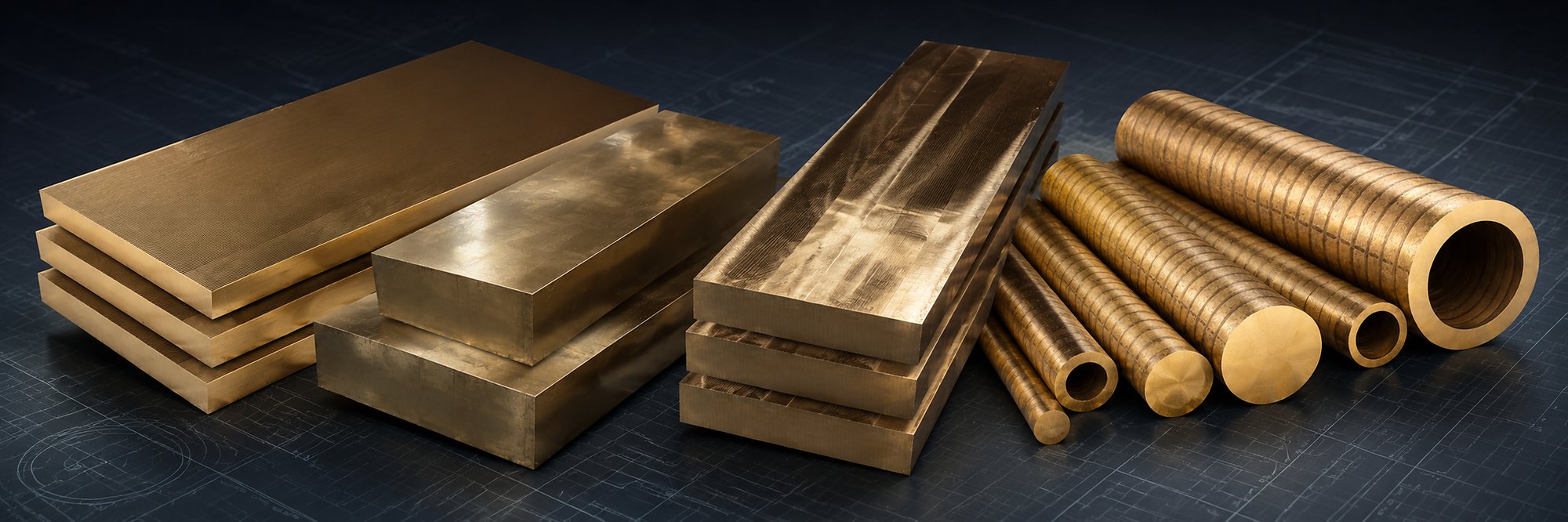
Aluminum bronze is a family of copper-based alloys distinguished by aluminum as their primary alloying element, typically present at 5% to 12% by weight. Unlike traditional bronzes that rely on tin, aluminum bronze combines copper with aluminum and often small amounts of iron, nickel, and manganese to produce a material with exceptional strength, outstanding corrosion resistance, and reliable wear performance.
This combination makes aluminum bronze a go-to material for components that operate in demanding environments. Maritime industry pumps and propellers, oil and gas equipment, aerospace landing gear, steel mill components, and heavy industrial machinery all rely on its unique balance of properties.
AMPCO METAL has pioneered the development of aluminum bronze alloys since 1914, building over a century of metallurgical expertise into the AMPCO® product line. This guide explains what aluminum bronze is, how it is composed, and where it performs best.
What is aluminum bronze?
Aluminum bronze is a copper alloy in which aluminum (5-12%) replaces tin as the principal alloying element. The aluminum content gives the alloy a distinctive golden color and confers significant mechanical and chemical advantages over standard bronzes. The material is known for:
- High tensile strength and yield strength
- Excellent resistance to corrosion, particularly in seawater and acidic media
- Superior wear and galling resistance
- Good performance at elevated temperatures
- Non-sparking and non-magnetic behavior
These characteristics place aluminum bronze among the most versatile engineering alloys, with applications ranging from precision aerospace components to large-scale marine propellers and steel mill components.
Chemical composition
The general composition of aluminum bronze includes:
|
Element |
Typical range |
|
Copper (Cu) |
76 – 95% |
|
Aluminum (Al) |
5 – 12% |
|
Iron (Fe) |
0 – 5% |
|
Nickel (Ni) |
0 – 5% |
|
Manganese (Mn) |
0 – 2% |
The exact recipe varies by grade and intended application. Higher aluminum content increases hardness and tensile strength but reduces ductility. Iron acts as a grain refiner and adds strength. Nickel significantly improves corrosion resistance, especially against pitting and stress corrosion in marine environments. Manganese enhances castability and adds toughness.
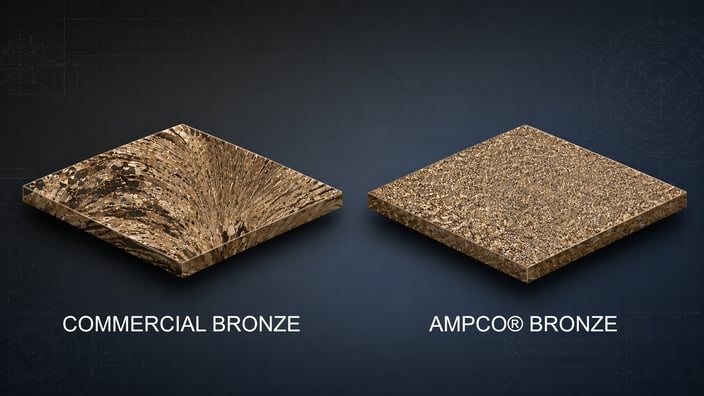
The way an alloy is melted, cast, and worked also matters. At AMPCO METAL, the patented MICROCAST® process applies magneto-hydro-dynamic stirring during casting to deliver an exceptionally uniform fine-grain microstructure, which translates directly into more consistent mechanical properties and longer service life.
Mechanical and physical properties
Aluminum bronze offers a property profile that few other copper alloys can match:
|
Property |
Typical range |
|
Tensile strength |
480 – 1000 MPa |
|
Yield strength |
250 – 790 MPa |
|
Elongation |
5 – 42% |
|
Hardness (Brinell) |
130 – 420 HB |
|
Density |
6.8 – 8.0 g/cm³ |
|
Melting point |
1,030 – 1,080 °C |
|
Thermal conductivity |
33 – 63 W/m·K |
Specific values depend on the grade and whether the material is cast, wrought, or heat-treated. Aluminum bronze also retains its mechanical properties at temperatures up to roughly 350 °C, which extends its useful range well beyond many other copper alloys.
Why aluminum bronze comes
in different grades
There is no single aluminum bronze. The category covers many formulations, each tuned for a specific balance of strength, ductility, wear resistance, corrosion behavior, and machinability.
The AMPCO® product line is structured around this principle:
- General-purpose grades favor ductility and corrosion resistance for marine, process and general mechanical engineering applications, including AMPCO® 8 and AMPCO® 18
- Heat-treated high-strength grades address heavy-duty load and impact applications, such as AMPCO® 18.23 and AMPCO® 18.136
- Hard alloys maximize hardness and wear resistance for forming tools and metalworking, including AMPCO® 21, AMPCO® 22, AMPCO® 25, and AMPCO® 26
- Premium high-performance grades meet the most demanding aerospace and safety-critical specifications, including AMPCO® 45 and AMPCO® M4
Several AMPCO® grades comply with aerospace and industrial standards, with the applicable specification depending on the product form. AMPCO® 45 meets AMS 4640 and ASTM B 150 for extrusions and AMS 4880 for castings. AMPCO® M4 meets AMS 4590 for extrusions and AMS 4881 for castings.
A subset (AMPCO® 8, AMPCO® 18, AMPCO® 22 and AMPCO® M4) is also approved for food-contact applications.
Applications of aluminum bronze
The combination of strength, corrosion resistance, and wear resistance makes aluminum bronze suitable for some of the most demanding industrial environments.
Marine and offshore
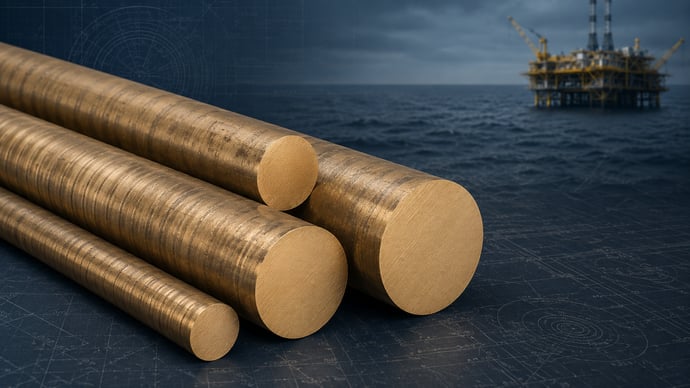
Seawater pumps, valves, propellers, shaft sleeves, and fasteners. Aluminum bronze resists biofouling and stands up to constant exposure to seawater without significant degradation. AMPCO® 8 and AMPCO® 18 are common references for marine and process components.
Oil and gas
Drilling equipment, downhole tools, and components exposed to acidic media or high-pressure environments. Sour gas applications often specify aluminum bronze for its resistance to hydrogen sulfide.
Aerospace
Landing gear bushings, valve guides, and bearing components. The alloy's high strength-to-weight ratio and reliability under cyclic loading make it well suited for critical aerospace parts. AMPCO® M4 and AMPCO® 45 are widely specified for aerospace bearings and bushings, with the applicable standard depending on the product form. AMPCO® 45 meets AMS 4640 and ASTM B 150 for extrusions and AMS 4880 for castings. AMPCO® M4 meets AMS 4590 for extrusions and AMS 4881 for castings.
Steel mill components
Slipper pads, screw-down nuts, and high-impact wear parts. Heat-treated grades such as AMPCO® 18.136 are engineered specifically for these high-load, high-impact environments.
Tube bending and metal forming
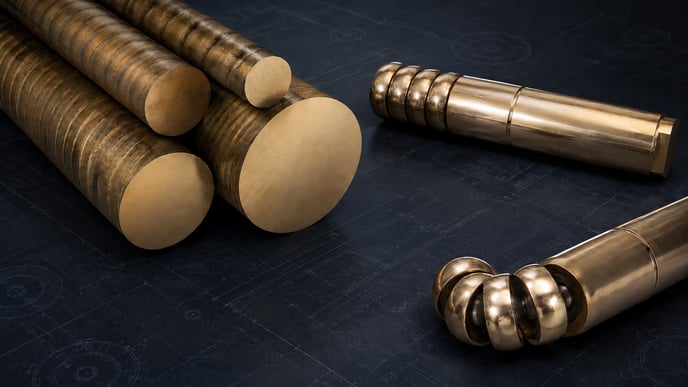
Tube bending mandrels, forming rolls, and drawing dies. When stainless steel is being formed, aluminum bronze prevents nickel pickup and galling that plague tool steels. AMPCO® 21, AMPCO® 22, AMPCO® 25, and AMPCO® 26 are engineered for these use cases.
Industrial machinery
Bearings, gears, worm wheels, slide plates, and valve seats. Aluminum bronze handles heavy loads with minimal galling, even in dry or marginally lubricated conditions.
Defense and safety
Non-sparking tools, manufacturing of ammunition, defense equipement and equipment for explosive atmospheres. The non-magnetic and non-sparking properties of aluminum bronze are essential for these safety-critical applications. AMPCO® 45 and AMPCOLOY® 83 are frequent references for non-sparking safety tools.
Plastic injection molding
Mold inserts and cores where high thermal conductivity, dimensional stability, and resistance to wear are needed for long production runs.
Advantages of Aluminium Bronze
- High strength comparable to medium-carbon steel
- Outstanding resistance to corrosion in seawater, brine, and many acids
- Excellent wear and galling resistance
- Retains properties at elevated temperatures (up to roughly 350 °C)
- Non-magnetic and non-sparking
- Good fatigue resistance
- Fully recyclable
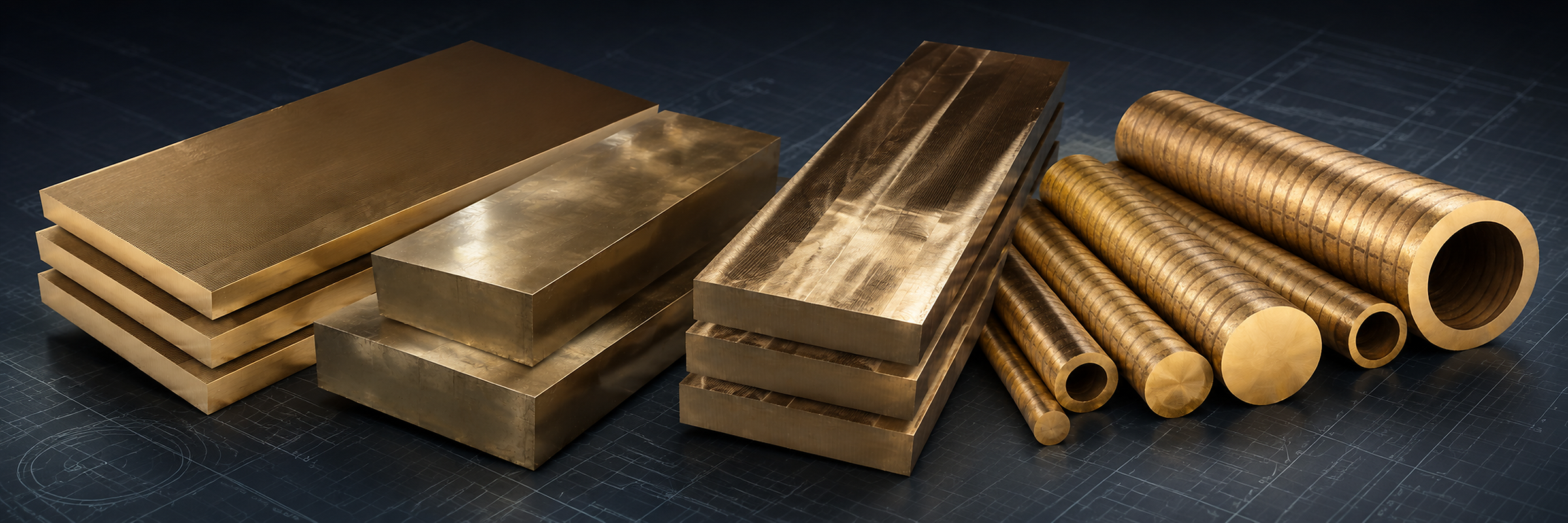
- Bar and rod (round, rectangle, hexagonal)
- Plates and tubes
- Billets and rings
- Forgings and extrusions
- Continuous and centrifugal castings
- Sand castings
Forms and availability
Aluminum bronze is produced in a wide range of forms to suit different manufacturing processes:
The form selected depends on part size, required properties, and downstream operations such as machining, welding, or heat treatment.
Frequently asked questions
-
Is aluminum bronze stronger than steel?
Some aluminum bronze grades reach tensile strengths similar to medium-carbon steel (550-900 MPa) while offering significantly better corrosion resistance and non-sparking, non-magnetic behavior. The choice between the two depends on the specific environment and requirements. -
Does aluminum bronze rust?
Aluminum bronze does not rust the way ferrous metals do. The aluminum content forms a thin, tightly adhering oxide layer on the surface that protects the underlying metal from further corrosion, even in seawater. -
Is aluminum bronze the same as bronze?
No. Traditional bronze is a copper-tin alloy. Aluminum bronze uses aluminum (5-12%) instead of tin as the main alloying element, which gives it different properties, generally higher strength and superior corrosion resistance. -
Is aluminum bronze magnetic?
No. Aluminum bronze is non-magnetic, which makes it useful in applications where magnetic interference must be avoided. -
Can aluminum bronze be welded?
Yes, but it requires appropriate procedures. TIG and MIG welding are commonly used. Pre-heating, careful control of heat input, and use of matching filler metals help prevent hot cracking and preserve mechanical properties. -
Is aluminum bronze food-safe?
Specific grades are. AMPCO® 8, AMPCO® 18, AMPCO® 22 and AMPCO® M4 are approved for food-contact applications.
Next step: choosing the right grade
The properties described above are typical for the aluminum bronze family overall, but the right grade for any given application depends on the specific combination of loads, temperatures, corrosive media, and tooling environment you are working with.
The next post in this series - AMPCO® Aluminum Bronze Grades: How to Choose the Right One — walks through the AMPCO® product range and provides a decision framework for matching a grade to your application.
For tailored guidance, AMPCO METAL's engineering team can help select the right grade and form for your project.
