---
title: "AMPCO® Aluminum Bronze vs. Standard: The MICROCAST® Advantage"
description: "Why AMPCO® aluminum bronze outperforms generic aluminum bronze: MICROCAST® production technology, certified standards, and total cost of ownership compared"
image: https://academy.ampcometal.com/hubfs/AMPCO%20Microcast.png
---
[](https://academy.ampcometal.com/)
- Products
- AMPCO® Aluminium Bronze
- [AMPCO® 8](https://www.ampcometal.com/products/ampco-aluminum-bronze/ampco-8/)
- [AMPCO® 15](https://www.ampcometal.com/products/ampco-aluminum-bronze/ampco-15/)
- [AMPCO® 18](https://www.ampcometal.com/products/ampco-aluminum-bronze/ampco-18/)
- [AMPCO® 18.136](https://www.ampcometal.com/products/ampco-aluminum-bronze/ampco-18-136/)
- [AMPCO® 18.22](https://www.ampcometal.com/products/ampco-aluminum-bronze/ampco-18-22//)
- [AMPCO® 18.23](https://www.ampcometal.com/products/ampco-aluminum-bronze/ampco-18-23/)
- [AMPCO® 21](https://www.ampcometal.com/products/ampco-aluminum-bronze/ampco-21/)
- [AMPCO® 22](https://www.ampcometal.com/products/ampco-aluminum-bronze/ampco-22/)
- [AMPCO® 25](https://www.ampcometal.com/products/ampco-aluminum-bronze/ampco-25/)
- [AMPCO® 26](https://www.ampcometal.com/products/ampco-aluminum-bronze/ampco-26/)
- [AMPCO® 45](https://www.ampcometal.com/products/ampco-aluminum-bronze/ampco-45/)
- [AMPCO® M4](https://www.ampcometal.com/products/ampco-aluminum-bronze/ampco-m4/)
- AMPCOLOY® High Copper Alloy
- [AMPCOLOY® 83](https://www.ampcometal.com/products/ampcoloy-high-copper-alloy/ampcoloy-83/)
- [AMPCOLOY® 88](https://www.ampcometal.com/products/ampcoloy-high-copper-alloy/ampcoloy-88/)
- [AMPCOLOY® 89](https://www.ampcometal.com/products/ampcoloy-high-copper-alloy/ampcoloy-89/)
- [AMPCOLOY® 91](https://www.ampcometal.com/products/ampcoloy-high-copper-alloy/ampcoloy-91/)
- [AMPCOLOY® 95](https://www.ampcometal.com/products/ampcoloy-high-copper-alloy/ampcoloy-95/)
- [AMPCOLOY® 940](https://www.ampcometal.com/products/ampcoloy-high-copper-alloy/ampcoloy-940/)
- [AMPCOLOY® 944](https://www.ampcometal.com/products/ampcoloy-high-copper-alloy/ampcoloy-944/)
- [AMPCOLOY® 972](https://www.ampcometal.com/products/ampcoloy-high-copper-alloy/ampcoloy-972/)
- [Cu-W Sintered](https://www.ampcometal.com/products/ampcoloy-high-copper-alloy/cu-w-sintered)
- AMS Alloys
- [AMS 4590](https://www.ampcometal.com/products/ams-alloys/ams-4590/)
- [AMS 4640](https://www.ampcometal.com/products/ams-alloys/ams-4640/)
- [AMS 4880](https://www.ampcometal.com/products/ams-alloys/ams-4880/)
- [AMS 4881](https://www.ampcometal.com/products/ams-alloys/ams-4881/)
- [Standard Alloys](https://www.ampcometal.com/products/standard-alloys/)
- [Welding Wire](https://www.ampcowelding.com/)
- [Safety Tools](https://www.safetytools.com/)
- Solutions
- Applications
- [Wear Resistance](https://www.ampcometal.com/applications/wear-resistance/)
- [Corrosion Resistance](https://www.ampcometal.com/applications/corrosion-resistance/)
- [Metal Forming & Tooling](https://www.ampcometal.com/applications/metal-forming/)
- [Die Casting](https://www.ampcometal.com/applications/die-casting/)
- [Plastic Processing](https://www.ampcometal.com/applications/plastic-processing/)
- [Resistance Welding](https://www.ampcometal.com/applications/resistance-welding/)
- Industries
- [Aerospace](https://www.ampcometal.com/industries/aerospace/)
- [Automotive](https://www.ampcometal.com/industries/automotive/)
- [General Engineering](https://www.ampcometal.com/industries/general-engineering/)
- [Marine](https://www.ampcometal.com/industries/marine/)
- [Metal Forming](https://www.ampcometal.com/industries/metal-forming/)
- [Oil, Gas & Chemical](https://www.ampcometal.com/industries/oil-gas-chemical/)
- [Plastic Processing](https://www.ampcometal.com/industries/plastic-processing/)
- [Resistance Welding](https://www.ampcometal.com/industries/resistance-welding/)
- [Steel](https://www.ampcometal.com/industries/steel)
- [Hydrogen](https://www.ampcometal.com/industries/hydrogen)
- [Luxury](https://www.ampcometal.com/industries/luxury)
- [Finished Machine Parts](https://www.ampcometal.com/finished-machined-parts/)
- [Additive Manufacturing](https://www.ampcometal.com/additive-manufacturing/)
- [Technical Consulting](https://www.ampcometal.com/technical-consulting/)
- Who We Are
- [Sustainability](https://www.ampcometal.com/sustainability/)
- [Sustainability Management](https://www.ampcometal.com/sustainability/sustainability-management/)
- [Environment](https://www.ampcometal.com/sustainability/environment/)
- [Social](https://www.ampcometal.com/sustainability/social/)
- [Governance](https://www.ampcometal.com/sustainability/governance/)
- [Future Goals](https://www.ampcometal.com/sustainability/furure-goals/)
- [Our History](https://www.ampcometal.com/our-history/)
- [About Us](https://www.ampcometal.com/about-us/)
- [Working at AMPCO](https://www.ampcometal.com/working-at-ampco)
- [Working with AMPCO](https://www.ampcometal.com/working-with-ampco)
- Technical Hub
- Technical Data
- [Application Datasheets](https://www.ampcometal.com/application-datasheets/)
- [Technical Datasheets](https://www.ampcometal.com/technical-datasheets/)
- [Microcast® Technology](https://www.ampcometal.com/mirocast-technology/)
- [Machining Recommendations](https://www.ampcometal.com/machining-recommendations/)
- Documentation
- [Safety Data Sheets](https://www.ampcometal.com/safety-data-sheets/)
- [Certifications](https://www.ampcometal.com/certifications/)
- [Food Approval Data](https://www.ampcometal.com/food-approval-data/)
- [Sales Terms and Conditions](https://www.ampcometal.com/sales-terms-and-conditions/)
- [ATEX Certification Data](https://www.ampcometal.com/atex-certification-data/)
- [Product Selection Tool](https://www.ampcometal.com/product-selection-tool/)
- [Stock Availability](https://www.ampcometal.com/ssd/)
- [Academy](https://academy.ampcometal.com/)
- [Contact](https://www.ampcometal.com/contact-us/#contact-us)
- [English](https://academy.ampcometal.com/blog/ampco-vs-standard-aluminum-bronze-microcast)
- [Deutsch](https://academy.ampcometal.com/de/ampco-aluminiumbronze-im-vergleich-zum-standard-der-microcast-vorteil)
- [Français](https://academy.ampcometal.com/fr/bronze-daluminium-ampco-vs-bronze-standard-lavantage-microcast)
- [Português - Brasil](https://academy.ampcometal.com/pt-br/bronze-de-alumínio-ampco-x-bronze-de-alumínio-comum-a-vantagem-do-microcast)
# AMPCO® Aluminum Bronze vs. Standard: The MICROCAST® Advantage
Jun 8, 2026 11:48:30 AM | Written by [AMPCO METAL](https://academy.ampcometal.com/author/ampco-metal)
- [Tweet](https://twitter.com/share)
The chemical composition of an aluminum bronze defines what it could be. The manufacturing process defines what it actually is in service. Two materials with identical compositions can deliver wildly different performance depending on how they were melted, cast, and worked.
This is the difference between standard aluminum bronze and AMPCO® aluminum bronze and the reason engineers in aerospace, steel mill, marine, and forming-tool industries continue to specify AMPCO® for critical components even when generic equivalents are available at lower up-front cost.
### What "standard aluminum bronze" usually means
When a buyer specifies "aluminum bronze" without further qualification, what arrives is typically:
- A grade matching the chemical composition envelope of a generic designation
- Cast or extruded under conventional process controls
- Tested against a basic batch certificate
That is often adequate for general-purpose components. But it leaves several performance levers untouched: grain size, microstructural uniformity, inclusion content, and lot-to-lot consistency. In demanding applications, those untouched levers translate directly into shorter service life, tighter machining tolerances missed, and unpredictable failure modes.
.jpg?width=686&height=386&name=AMPCO%20Aluminium%20Bronzes%20(1).jpg)
### What AMPCO® aluminum bronze does differently
###### 1. MICROCAST® production technology
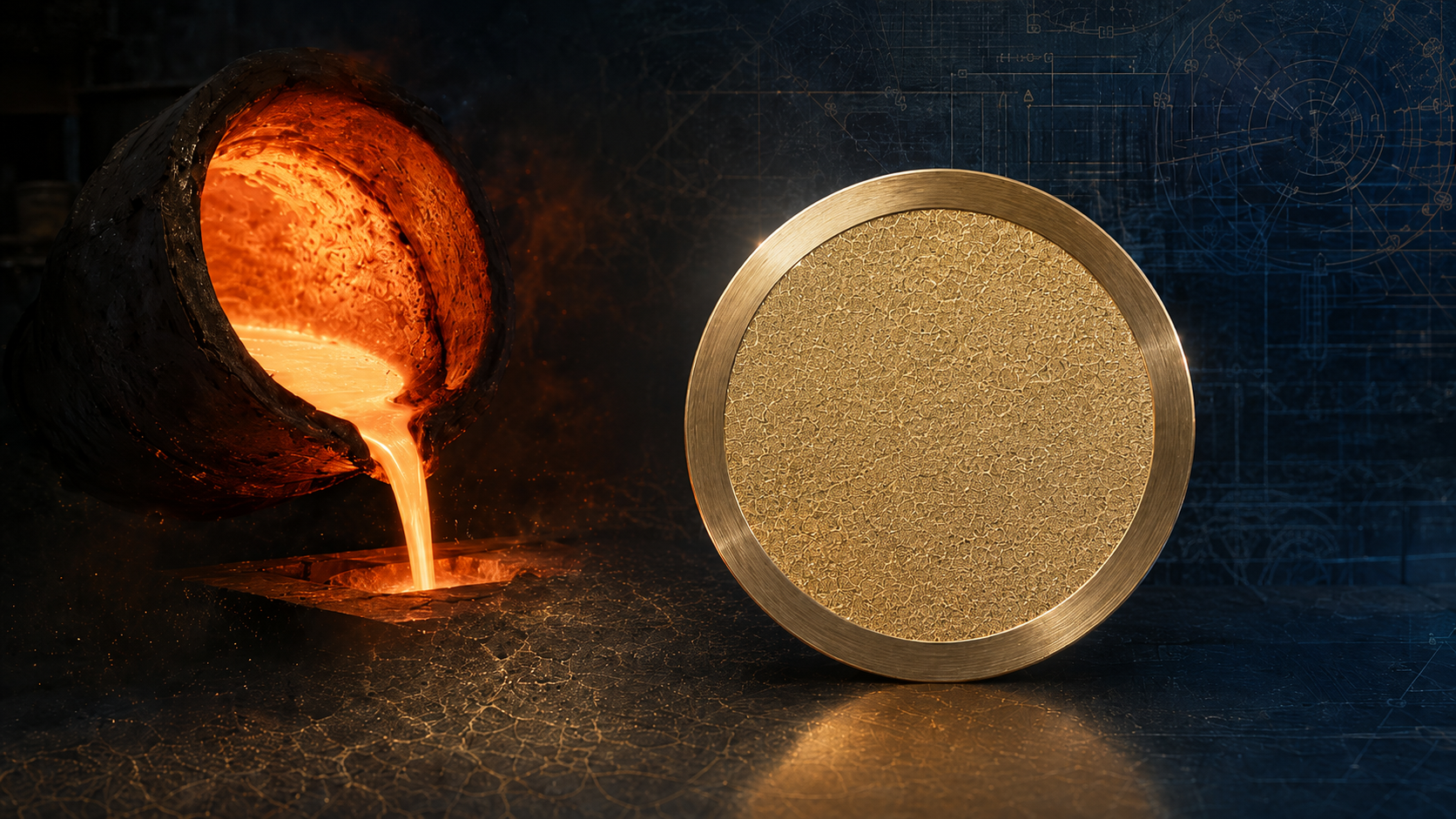
[MICROCAST®](https://www.ampcometal.com/technical-data/microcast-technology/?utm_source=inblog_link&utm_medium=blog&utm_campaign=AMPCO%C2%AE+Aluminum+Bronze+vs.+Standard&utm_id=626&utm_term=BOFU) is AMPCO METAL's patented casting technology. It applies magneto-hydro-dynamic (MHD) stirring during solidification, which produces:
- Extremely fine grain size
- Uniform microstructure throughout the cross-section
- Even dispersion of hard phases (such as the gamma 2 phase in high-aluminum grades)
- Reduced segregation and lower inclusion content
Why this matters in service:
- Wear surfaces fail less from local microstructural variation
- Machined surfaces deliver more predictable finishes
- Heat-treated grades respond more uniformly to thermal cycles
- Fatigue life increases because there are fewer crack initiation sites
This is the most underestimated specification dimension in aluminum bronze procurement. Two bars with the same chemistry but different microstructures will behave like two different materials in a wear application.
###### 2. Over a century of metallurgical engineering
AMPCO METAL has been developing aluminum bronze alloys since 1914. Several grades in the current [AMPCO® line](https://www.ampcometal.com/products/ampco-aluminium-bronze/?utm_source=inblog_link&utm_medium=blog&utm_campaign=AMPCO%C2%AE+Aluminum+Bronze+vs.+Standard&utm_id=626&utm_term=BOFU), including AMPCO® 25 and AMPCO® 26, are patented formulations developed for specific industrial pain points (stainless steel drawing, high-compression forming) that generic aluminum bronze cannot address.
This is not just brand heritage. It is an installed base of application data: every major industry that specifies aluminum bronze has reference parts running AMPCO® alloys, and those reference parts inform ongoing grade refinement.
###### 3. Standards compliance and traceability
AMPCO® grades carry industry-standard compliance where it matters:
- AMPCO® M4: AMS 4590 for extrusions, AMS 4881 for castings
- AMPCO® 45: AMS 4640 and ASTM B 150 for extrusions, AMS 4880 for castings
- AMPCO® 8, AMPCO® 18, AMPCO® 22, and AMPCO® M4: approved for food-contact applications
Generic aluminum bronze that nominally falls in the same chemical envelope does not automatically qualify against these specifications. The certifications require a documented production chain, traceable raw materials, and verifiable process controls, all of which are intrinsic to [AMPCO METAL](https://www.ampcometal.com/?utm_source=inblog_link&utm_medium=blog&utm_campaign=AMPCO%C2%AE+Aluminum+Bronze+vs.+Standard&utm_id=626&utm_term=BOFU)'s operations and not retrofittable to a generic supply chain.
###### 4. Engineered grade specialization
A generic aluminum bronze supplier offers a handful of compositions and asks the buyer to make them fit. AMPCO offers a structured grade family where each formulation solves a specific problem:
- Forming stainless steel without nickel contamination - AMPCO® 22 or AMPCO® 25
- Handling the impact loads of a steel mill slipper - heat-treated AMPCO® 18.136
- Beryllium-free aerospace bearings - AMPCO® M4
- Non-sparking safety tools - AMPCO® 45
The right grade-for-application match avoids the common compromise where a buyer over-specifies (and overpays for) a premium grade, or under-specifies and pays for the mistake in early failure.
### Real-world impact: total cost of ownership
The up-front price-per-kilogram of a generic aluminum bronze is often lower than the AMPCO® equivalent. The total cost of ownership tells a different story.
| **Cost factor** | **Standard aluminum bronze** | **AMPCO® aluminum bronze** |
| --- | --- | --- |
| Up-front material cost | Lower | Higher |
| Machining consistency | Variable | Predictable |
| Tool life on finished parts | Variable | Higher |
| Service life of finished part | Variable | Higher and more predictable |
| Certification overhead | High (case-by-case) | Built in |
| Risk of premature replacement | Higher | Lower |
| Downtime cost exposure | Higher | Lower |
In components where downtime is expensive, aerospace bushings, steel mill slippers, stainless-steel-forming dies, the predictability and service life premium pays for itself many times over the lifecycle of the part.
### Where the difference shows up most clearly
###### Aerospace landing gear bushings
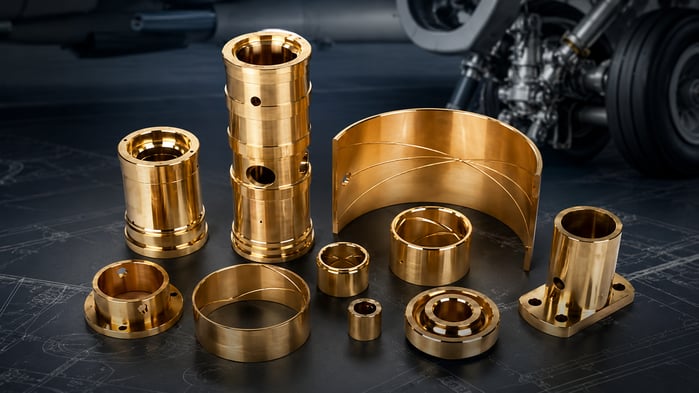
Compliance with AMS 4590 is non-negotiable. [AMPCO® M4](https://www.ampcometal.com/products/ampco-aluminium-bronze/ampco-m4/?utm_source=inblog_link&utm_medium=blog&utm_campaign=AMPCO%C2%AE+Aluminum+Bronze+vs.+Standard&utm_id=626&utm_term=BOFU) is a reference material here precisely because its production chain is fully qualified, to AMS 4590 for extrusions and AMS 4881 for castings, and its microstructure is uniform enough to deliver consistent fatigue behavior across thousands of parts.
###### Stainless steel drawing dies
Standard aluminum bronze in the right composition envelope can form stainless steel, but tolerance drift and die wear are common. [AMPCO® 22](https://www.ampcometal.com/products/ampco-aluminium-bronze/ampco-18-22/?utm_source=inblog_link&utm_medium=blog&utm_campaign=AMPCO%C2%AE+Aluminum+Bronze+vs.+Standard&utm_id=626&utm_term=BOFU)and [AMPCO® 25](https://www.ampcometal.com/products/ampco-aluminium-bronze/ampco-25/?utm_source=inblog_link&utm_medium=blog&utm_campaign=AMPCO%C2%AE+Aluminum+Bronze+vs.+Standard&utm_id=626&utm_term=BOFU), with their controlled duplex and hard-phase microstructures, extend die life and hold tighter tolerances over long production runs.
###### Steel mill slipper pads
Impact loading combined with sliding wear destroys ordinary bronze quickly. Heat-treated [AMPCO® 18.136](https://www.ampcometal.com/products/ampco-aluminium-bronze/ampco-18-136/?utm_source=inblog_link&utm_medium=blog&utm_campaign=AMPCO%C2%AE+Aluminum+Bronze+vs.+Standard&utm_id=626&utm_term=BOFU) was engineered specifically for this duty cycle, with a 40% improvement in impact strength over its base grade.
###### Non-sparking safety tools
For tools used in explosive atmospheres, spark-resistance behavior must be reliable batch after batch. [AMPCO® 45](https://www.ampcometal.com/products/ampco-aluminium-bronze/ampco-45/?utm_source=inblog_link&utm_medium=blog&utm_campaign=AMPCO%C2%AE+Aluminum+Bronze+vs.+Standard&utm_id=626&utm_term=BOFU) delivers that consistency through controlled chemistry and microstructure, a generic aluminum bronze cannot guarantee equivalent behavior across production lots.
### When standard aluminum bronze is the right call
This is not a blanket argument against generic aluminum bronze. There are applications where up-front cost savings dominate the analysis, non-critical components in mild service, prototype parts, or wear items with very short replacement cycles. For those, a generic grade is often the right call.
But for any part where service life, predictability, certification, or downtime cost is in play, the AMPCO® production chain is where the math works out in the buyer's favor.
### How to validate the choice for your application
The best way to confirm whether an AMPCO® grade is the right fit is to put the specifics of your application, loading, environment, dimensions, certification requirements, expected service life in front of AMPCO METAL's engineering team. They can:
- Recommend the optimal grade from the AMPCO® range
- Provide certified technical data sheets
- Advise on form, dimensional capabilities, and machining
- Help cost out the lifecycle picture against a generic alternative
For applications where critical components are involved, that conversation is the highest-leverage step in the procurement process.
[](https://cta-redirect.hubspot.com/cta/redirect/5331421/8da01823-dd9b-42be-91b8-c4efd4d4c1ea)
-
-
-
-
- [Terms of use](https://www.ampcometal.com/terms-of-use/)
- [Privacy](https://www.ampcometal.com/privacy/)
- [Links](https://www.ampcometal.com/links/)
- [Sitemap](https://www.ampcometal.com/sitemap/)
- [Code of ethics and conduct](https://www.ampcometal.com/documents/CODE-of-ETHICS-and-CONDUCT.pdf)
© 2026 AMPCO METAL