
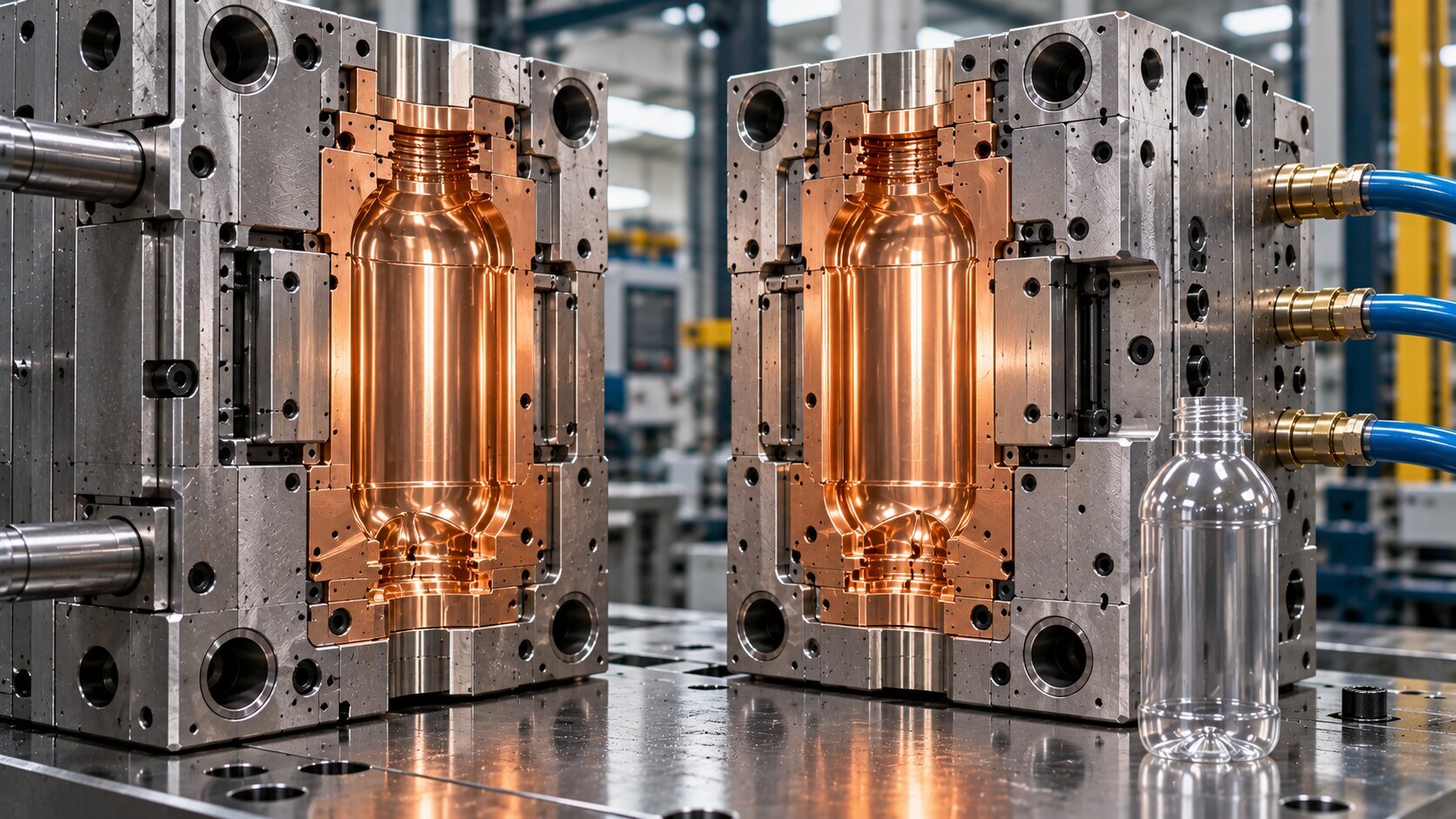
Heat transfer bottlenecks occur when the mold material cannot conduct heat away from the cavity as quickly as the process requires.
This results in uneven cooling across the part, which can cause defects or force manufacturers to extend cycle time to avoid them.
Companies often notice these problems only after they accumulate into bigger issues, such as higher scrap rates, added rework, lower productivity, and unplanned mold maintenance.
This article will explore:
-
What Causes Heat Transfer Bottlenecks in Molds?
-
How Does This Affect the Business?
-
What Options Do Companies Have When It Comes to These Problems?
What Causes Heat Transfer Bottlenecks
in Molds?
Heat transfer bottlenecks trace back to the mold material's heat transfer capability. Conductivity comparison data across common mold materials shows that as a mold's working temperature rises, some materials' ability to conduct heat does not improve.
Meanwhile, the thermal load on the mold stays the same, or even increases. This mismatch between the heat the process generates and the rate at which the mold material can carry it away is the root cause of the bottleneck.
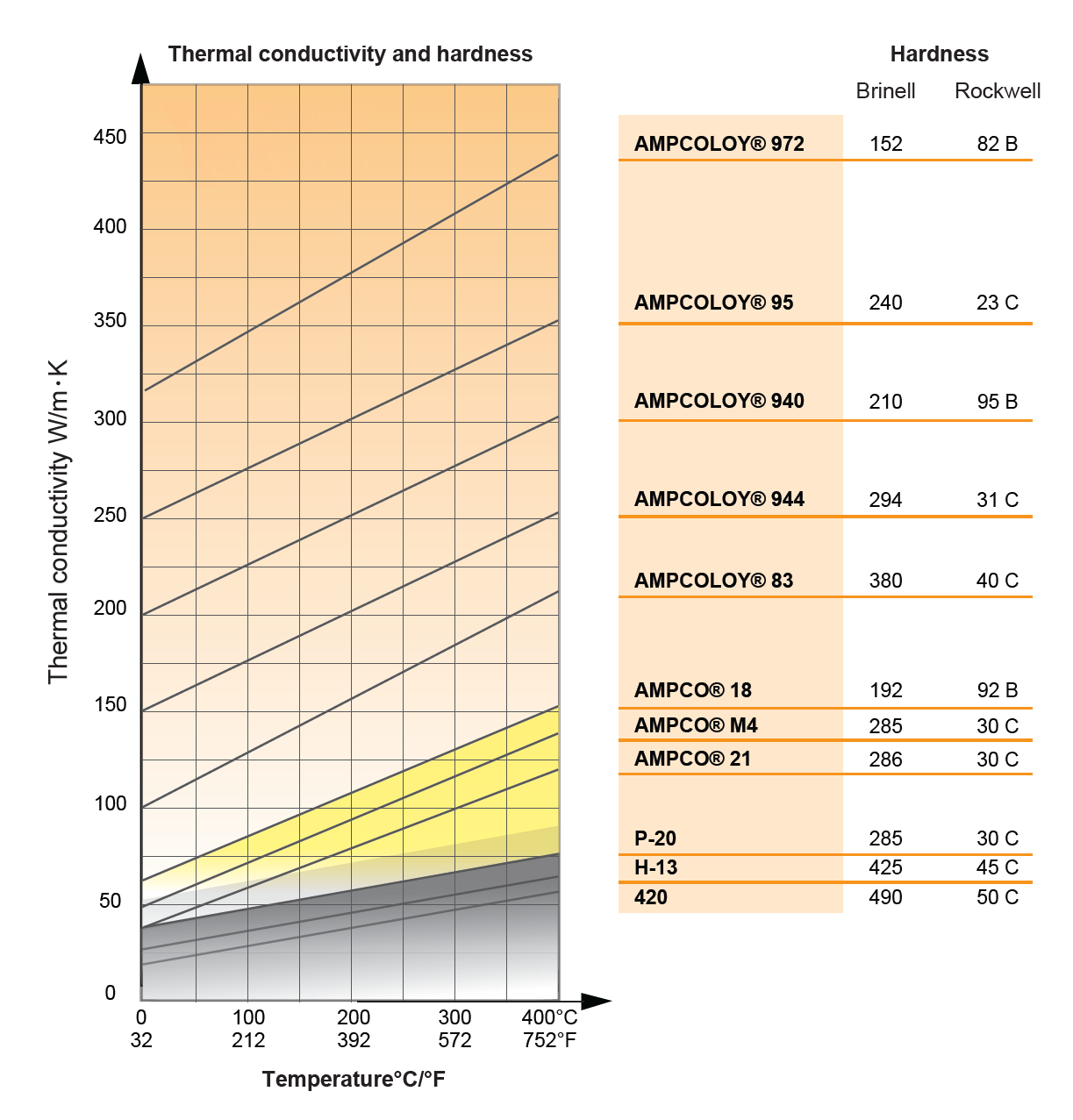
Comparison of thermal conductivity and hardness characteristics of copper alloys and conventional tool steels.
Another issue comes from mold geometry, such as thin ribs, deep cores, fine-textured cavity surfaces, and long or narrow profiles.
All of these can create zones where heat has farther to travel or less surrounding material through which to escape.
Because of these constraints, a standard mold material may be physically incapable of removing heat fast enough, extending cycle time regardless of how the cooling channels are arranged. This limitation is not a design flaw; it is a ceiling set by the conductivity of the material itself.
How Does This Affect the Business?
Companies rarely see the direct cost of heat transfer bottlenecks in injection molding. But they can see the effect in productivity.
For example, measuring cycle time under identical processing conditions, with cooling time as the only variable, showed an overall cycle of 9.6 to 9.7 seconds in H13 tool steel and 420 stainless steel, compared to 7.8 to 8.1 seconds in AMPCOLOY® 940 and AMPCOLOY® 83.
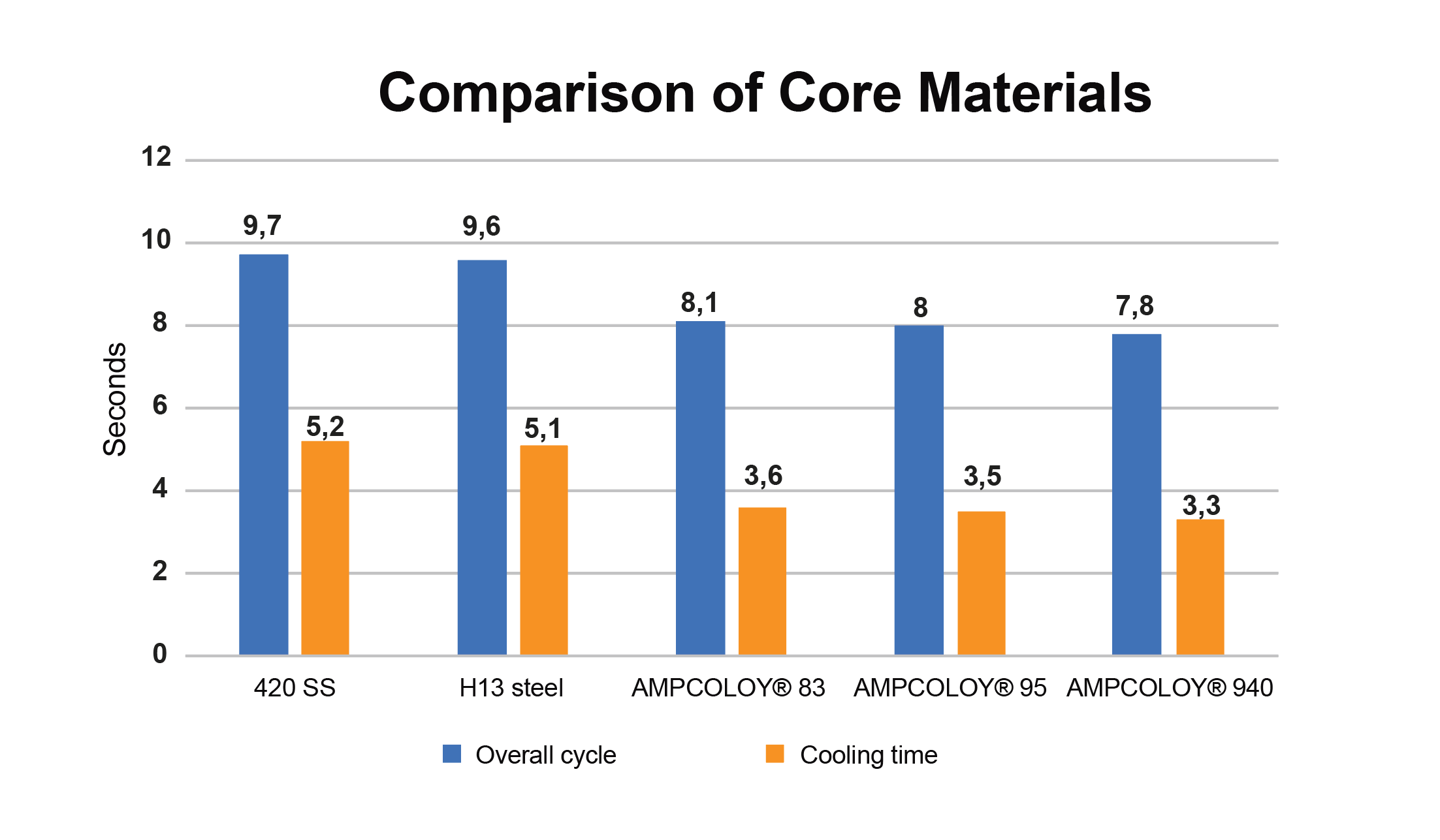
The difference came from the mold material itself. Cores with better heat transfer capability brought shorter cooling times. This can make a significant difference for companies that operate large production volumes.
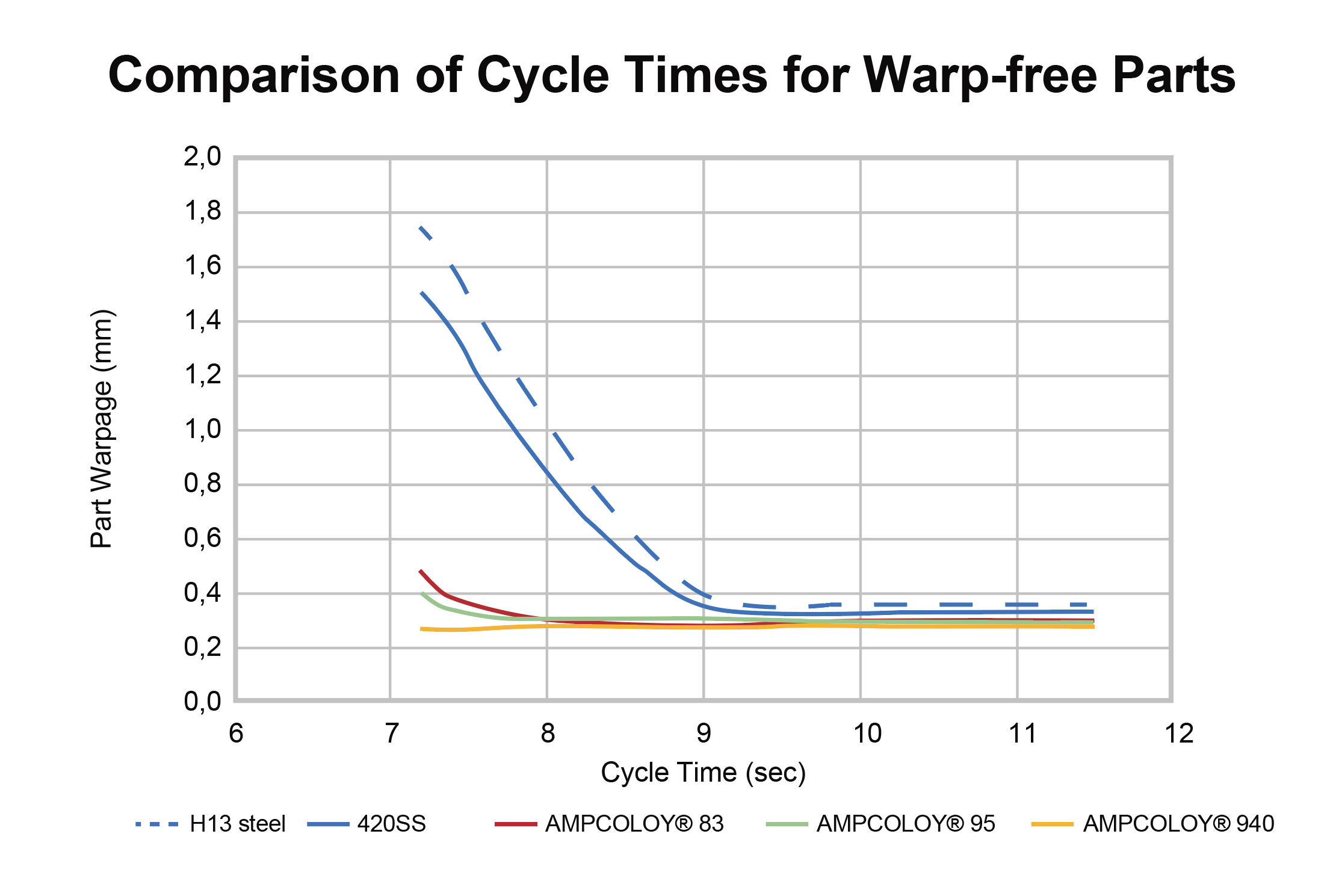
The same testing also tracked part warpage against cycle time and found that shorter cycles increased the amount of warpage in materials with lower heat transfer capability.
This creates an impractical situation for producers, who have to choose between shorter production time and consistent part quality.
But it can be reduced if companies use cores made from higher-conductivity materials, as the testing results showed.
Two other areas that can bring higher cost are the machining budget and the mold's operating life.
When companies choose materials that do not require additional heat treatment, they can decrease the number of servicing incidents.
Such materials also resist corrosion from PVC and other chemically aggressive resins. This adds another way molds avoid damage over time.
These molds also hold their dimensional accuracy longer. It shows that a heat transfer bottleneck in injection molding isn't an area that producers can ignore.
Why Conventional Approaches Fall Short?
When it comes to heat transfer bottlenecks in injection molding, there are several approaches to address it. Companies often choose aluminum as an alternative to steel, since it offers better thermal conductivity.
But they must accept a trade-off in wear resistance and hardness. That limits how long an aluminum insert holds its dimensional accuracy under repeated cycling.
That doesn't mean aluminum should never be used. It's a reasonable choice for lower-volume or short-run production. Companies with higher demands need to consider a different material.
Another way producers address heat transfer bottlenecks in injection molding is by slowing the cycle down. This extends cooling time until the part cools evenly enough to avoid warpage.
Professionals also use surface coatings to extend tool life or improve wear resistance. But a coating doesn't improve the material's ability to conduct heat away.
A third common solution is improving the cooling channel design, which can help but can be limited by the mold's geometry.
These are temporary workarounds. None of them resolve the actual cause of heat transfer bottlenecks in injection molding, which is the thermal conductivity of the mold material itself.
High-Conductivity Copper Alloys as the Engineering Solution
The direct answer is a mold material with meaningfully higher thermal conductivity than steel or aluminum, but with better hardness and wear resistance.
These properties can be found in high-conductivity copper alloys, engineered specifically to fill that role.
They can address heat transfer bottlenecks in injection molding because their thermal conductivity increases as the material's working temperature rises.
It offers the opposite behavior of steel, because steel's conductivity doesn't improve as heat increases.
Beryllium content in some of these alloys also contributes to their overall performance profile, combining conductivity with hardness and wear resistance, which supports their position as a stronger alternative to aluminum.
Facilities operating under stricter health and safety requirements can also choose beryllium-free variants. As a result, high-conductivity copper alloys can be used in producing food-contact plastic.
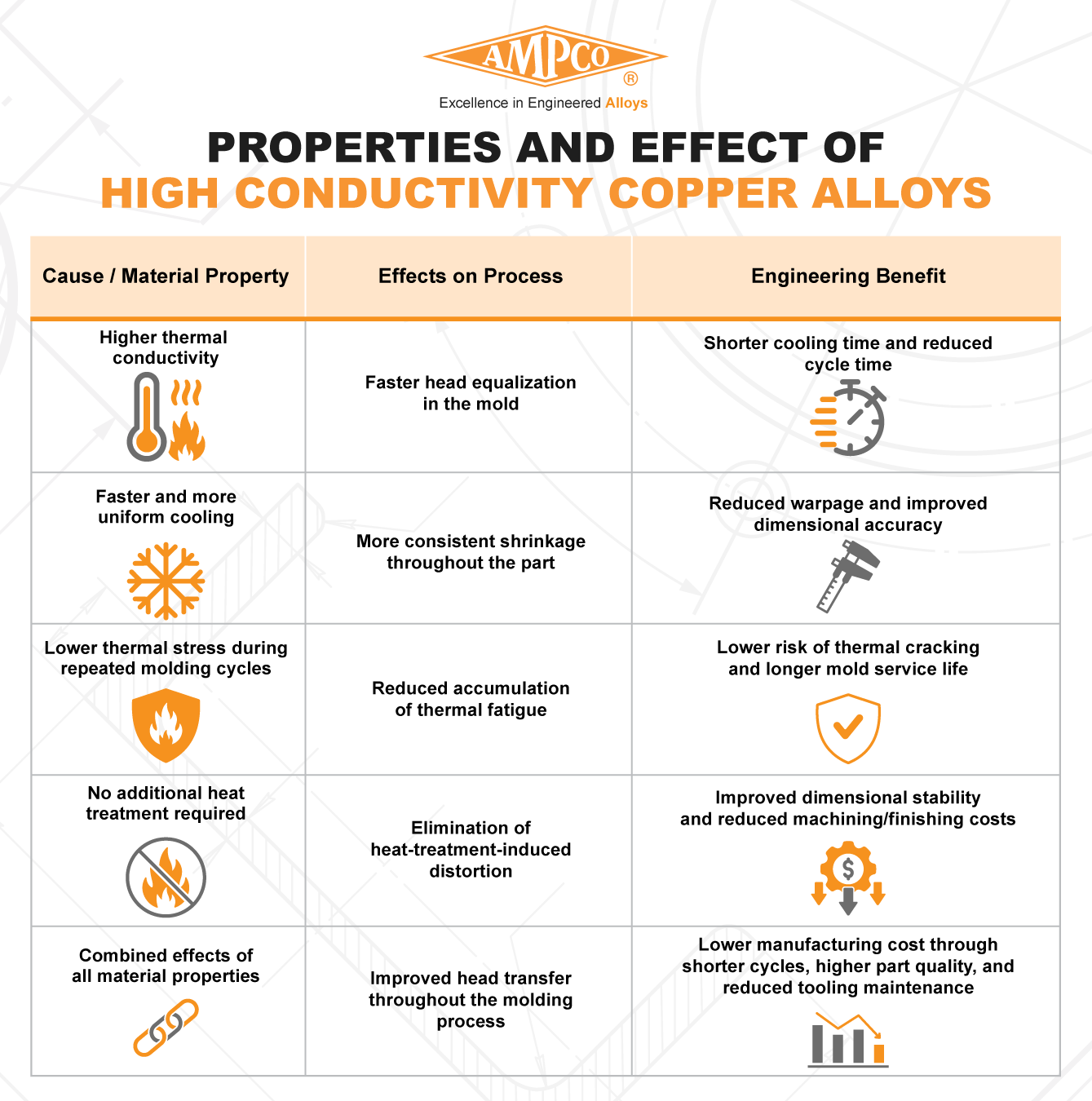
Thermal conductivity, heat extraction rate, and cycle time are the properties that directly influence heat transfer bottlenecks in injection molding.
A wide range of grades is also available, allowing producers to choose the right material for general-purpose molding through high-precision and regulated environments parts, extending their applicability beyond general industrial molding.
Frequently Asked Questions
How do I know if my mold has a heat transfer bottleneck?
Common signs include cycle times longer than expected for the part's size and geometry, recurring warpage or sink marks despite stable process settings, and cooling channels that seem well-designed but still aren't reducing cycle time. If cooling accounts for a disproportionate share of total cycle time, the mold material's conductivity is worth reviewing.
Why does slowing down the cycle only partly solve the issue?
Extending cycle time gives the part more time to cool evenly, which reduces warpage, but it does so by sacrificing the production output the mold was designed to deliver. It manages the symptom without changing the material property causing it.
Is switching mold materials worth the cost for lower-volume production?
Not always. For lower-volume or short-run tooling, the cycle time savings may not offset the material or machining cost difference. The decision typically depends on production volume, part quality requirements, and how much the current bottleneck is already costing in scrap, rework, or downtime.
Where It Applies in the Mold?
The starting point for a producer is to identify those parts that carry the heaviest thermal load, for example cooling inserts, cooling pins, or injection nozzles.
These are the parts where a heat transfer bottleneck in injection molding is most likely to originate.
So the right question isn't whether a bottleneck exists, but which part carries the most risk and how it's affecting production.
From there, producers can assess whether a material change would bring benefits in cycle time, part consistency, and machining or maintenance cost.
That assessment depends on the specifics of each mold and process. Contact AMPCO METAL's technical team to discuss operating temperature, cycle requirements, part geometry, and material options for your specific mold application.
