---
title: Reducing Downtime in Wear-Intensive Industries with Aluminum Bronze
description: Wear-intensive operations rely on aluminum bronze to limit surface degradation, extend service intervals, and maintain consistent equipment operation.
image: https://academy.ampcometal.com/hubfs/Steel%20mill%20A.jpg
---
[](https://academy.ampcometal.com/)
- Products
- AMPCO® Aluminium Bronze
- [AMPCO® 8](https://www.ampcometal.com/products/ampco-aluminum-bronze/ampco-8/)
- [AMPCO® 15](https://www.ampcometal.com/products/ampco-aluminum-bronze/ampco-15/)
- [AMPCO® 18](https://www.ampcometal.com/products/ampco-aluminum-bronze/ampco-18/)
- [AMPCO® 18.136](https://www.ampcometal.com/products/ampco-aluminum-bronze/ampco-18-136/)
- [AMPCO® 18.22](https://www.ampcometal.com/products/ampco-aluminum-bronze/ampco-18-22//)
- [AMPCO® 18.23](https://www.ampcometal.com/products/ampco-aluminum-bronze/ampco-18-23/)
- [AMPCO® 21](https://www.ampcometal.com/products/ampco-aluminum-bronze/ampco-21/)
- [AMPCO® 22](https://www.ampcometal.com/products/ampco-aluminum-bronze/ampco-22/)
- [AMPCO® 25](https://www.ampcometal.com/products/ampco-aluminum-bronze/ampco-25/)
- [AMPCO® 26](https://www.ampcometal.com/products/ampco-aluminum-bronze/ampco-26/)
- [AMPCO® 45](https://www.ampcometal.com/products/ampco-aluminum-bronze/ampco-45/)
- [AMPCO® M4](https://www.ampcometal.com/products/ampco-aluminum-bronze/ampco-m4/)
- AMPCOLOY® High Copper Alloy
- [AMPCOLOY® 83](https://www.ampcometal.com/products/ampcoloy-high-copper-alloy/ampcoloy-83/)
- [AMPCOLOY® 88](https://www.ampcometal.com/products/ampcoloy-high-copper-alloy/ampcoloy-88/)
- [AMPCOLOY® 89](https://www.ampcometal.com/products/ampcoloy-high-copper-alloy/ampcoloy-89/)
- [AMPCOLOY® 91](https://www.ampcometal.com/products/ampcoloy-high-copper-alloy/ampcoloy-91/)
- [AMPCOLOY® 95](https://www.ampcometal.com/products/ampcoloy-high-copper-alloy/ampcoloy-95/)
- [AMPCOLOY® 940](https://www.ampcometal.com/products/ampcoloy-high-copper-alloy/ampcoloy-940/)
- [AMPCOLOY® 944](https://www.ampcometal.com/products/ampcoloy-high-copper-alloy/ampcoloy-944/)
- [AMPCOLOY® 972](https://www.ampcometal.com/products/ampcoloy-high-copper-alloy/ampcoloy-972/)
- [Cu-W Sintered](https://www.ampcometal.com/products/ampcoloy-high-copper-alloy/cu-w-sintered)
- AMS Alloys
- [AMS 4590](https://www.ampcometal.com/products/ams-alloys/ams-4590/)
- [AMS 4640](https://www.ampcometal.com/products/ams-alloys/ams-4640/)
- [AMS 4880](https://www.ampcometal.com/products/ams-alloys/ams-4880/)
- [AMS 4881](https://www.ampcometal.com/products/ams-alloys/ams-4881/)
- [Standard Alloys](https://www.ampcometal.com/products/standard-alloys/)
- [Welding Wire](https://www.ampcowelding.com/)
- [Safety Tools](https://www.safetytools.com/)
- Solutions
- Applications
- [Wear Resistance](https://www.ampcometal.com/applications/wear-resistance/)
- [Corrosion Resistance](https://www.ampcometal.com/applications/corrosion-resistance/)
- [Metal Forming & Tooling](https://www.ampcometal.com/applications/metal-forming/)
- [Die Casting](https://www.ampcometal.com/applications/die-casting/)
- [Plastic Processing](https://www.ampcometal.com/applications/plastic-processing/)
- [Resistance Welding](https://www.ampcometal.com/applications/resistance-welding/)
- Industries
- [Aerospace](https://www.ampcometal.com/industries/aerospace/)
- [Automotive](https://www.ampcometal.com/industries/automotive/)
- [General Engineering](https://www.ampcometal.com/industries/general-engineering/)
- [Marine](https://www.ampcometal.com/industries/marine/)
- [Metal Forming](https://www.ampcometal.com/industries/metal-forming/)
- [Oil, Gas & Chemical](https://www.ampcometal.com/industries/oil-gas-chemical/)
- [Plastic Processing](https://www.ampcometal.com/industries/plastic-processing/)
- [Resistance Welding](https://www.ampcometal.com/industries/resistance-welding/)
- [Steel](https://www.ampcometal.com/industries/steel)
- [Hydrogen](https://www.ampcometal.com/industries/hydrogen)
- [Luxury](https://www.ampcometal.com/industries/luxury)
- [Finished Machine Parts](https://www.ampcometal.com/finished-machined-parts/)
- [Additive Manufacturing](https://www.ampcometal.com/additive-manufacturing/)
- [Technical Consulting](https://www.ampcometal.com/technical-consulting/)
- Who We Are
- [Sustainability](https://www.ampcometal.com/sustainability/)
- [Sustainability Management](https://www.ampcometal.com/sustainability/sustainability-management/)
- [Environment](https://www.ampcometal.com/sustainability/environment/)
- [Social](https://www.ampcometal.com/sustainability/social/)
- [Governance](https://www.ampcometal.com/sustainability/governance/)
- [Future Goals](https://www.ampcometal.com/sustainability/furure-goals/)
- [Our History](https://www.ampcometal.com/our-history/)
- [About Us](https://www.ampcometal.com/about-us/)
- [Working at AMPCO](https://www.ampcometal.com/working-at-ampco)
- [Working with AMPCO](https://www.ampcometal.com/working-with-ampco)
- Technical Hub
- Technical Data
- [Application Datasheets](https://www.ampcometal.com/application-datasheets/)
- [Technical Datasheets](https://www.ampcometal.com/technical-datasheets/)
- [Microcast® Technology](https://www.ampcometal.com/mirocast-technology/)
- [Machining Recommendations](https://www.ampcometal.com/machining-recommendations/)
- Documentation
- [Safety Data Sheets](https://www.ampcometal.com/safety-data-sheets/)
- [Certifications](https://www.ampcometal.com/certifications/)
- [Food Approval Data](https://www.ampcometal.com/food-approval-data/)
- [Sales Terms and Conditions](https://www.ampcometal.com/sales-terms-and-conditions/)
- [ATEX Certification Data](https://www.ampcometal.com/atex-certification-data/)
- [Product Selection Tool](https://www.ampcometal.com/product-selection-tool/)
- [Stock Availability](https://www.ampcometal.com/ssd/)
- [Academy](https://academy.ampcometal.com/)
- [Contact](https://www.ampcometal.com/contact-us/#contact-us)
# Reducing Downtime in Wear-Intensive Industries with Aluminum Bronze
Dec 19, 2025 7:23:19 PM | Written by [AMPCO METAL](https://academy.ampcometal.com/author/ampco-metal)
- [Tweet](https://twitter.com/share)
**Reducing downtime is one of the most effective ways to improve productivity in wear-intensive industries. Equipment that operates under constant friction and load faces steady material loss, but selecting the right alloy can significantly extend service life and maintain consistent performance.**
### **The Cost of Downtime in Wear-Intensive Operations**
In industries such as steel manufacturing, forming, and heavy machinery, downtime caused by wear-related failures can represent a major portion of total production losses. Each unscheduled stop requires equipment inspection, replacement of worn parts, and recalibration of production systems. Beyond the direct maintenance costs, downtime also leads to lost output, reduced delivery reliability, and increased operational strain on other equipment.
The financial impact of wear extends far beyond the cost of a single component. As machine elements degrade, friction increases, energy consumption rises, and process precision declines. Over time, these effects compound, creating an ongoing cycle of maintenance and reduced efficiency. To minimize this impact, materials with high [wear resistance](https://www.ampcometal.com/applications/wear-resistance/) and stability, such as aluminum bronze, are increasingly used in critical components that must operate reliably under continuous mechanical stress.
[If you are looking for more in-depth information, you can download our latest detailed technical paper: Improving Wear Resistance with High-Performance Copper Alloys](https://academy.ampcometal.com/landing-page-wear-resistance-2025?hsLang=en)
### How Wear Leads to Unplanned Maintenance and Interruptions
Wear is a gradual process, but its consequences often appear suddenly. As components lose material through abrasion, galling, or surface fatigue, tolerances shift and contact surfaces become uneven. This increases vibration, friction, and operating temperature, conditions that accelerate wear even further.
The result is a self-reinforcing cycle that eventually leads to system imbalance and failure. Bearings, bushings, and guides are especially vulnerable, as they operate under continuous sliding or rotational motion. When these parts degrade, the entire assembly may need to be stopped for inspection or repair.
Unplanned maintenance typically follows this pattern:
- **Initial surface degradation** reduces alignment and causes localized friction.
- **Increased heat and stress** accelerate deformation and galling.
- **Loss of dimensional precision** affects system balance and load distribution.
- **Sudden failure** occurs once the part can no longer withstand operational loads.
Interruptions caused by such wear not only reduce productivity but also disrupt maintenance schedules, increasing overall costs and decreasing equipment reliability.
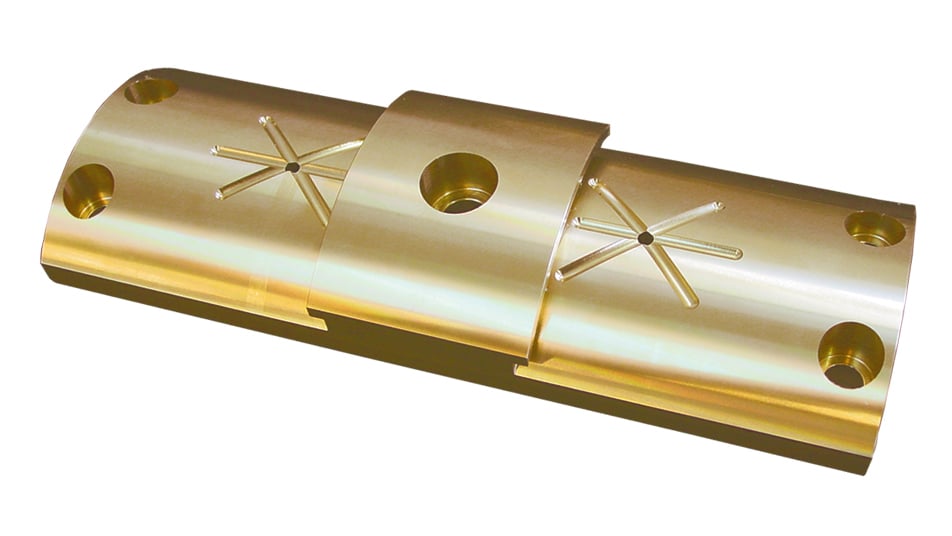
-1.jpg?width=1200&height=800&name=Blog%20images%201200x800%20(7)-1.jpg)
*AMPCO® Aluminum Bronze sliding plate*
### The Role of Aluminum Bronze in High-Wear Environments
[Aluminum bronze](https://www.ampcometal.com/products/ampco-aluminium-bronze/) is one of the most effective materials for reducing wear-related downtime in demanding applications. Its alloy composition combines high hardness with excellent resistance to galling, abrasion, and corrosion, properties that allow it to maintain surface integrity under heavy load and repetitive motion.
In steel mills, forming tools, and rolling applications, aluminum bronze is commonly used for bushings, wear plates, and guiding components. Its ability to resist metal-to-metal adhesion prevents surface scoring and reduces friction, even in limited-lubrication or high-temperature environments. The alloy’s natural toughness and dimensional stability also prevent deformation, which helps maintain alignment and reduces the need for frequent adjustments or part replacements.
These characteristics make aluminum bronze a preferred choice for components exposed to sliding or impact forces, where consistent performance and reduced maintenance directly contribute to improved operational uptime.
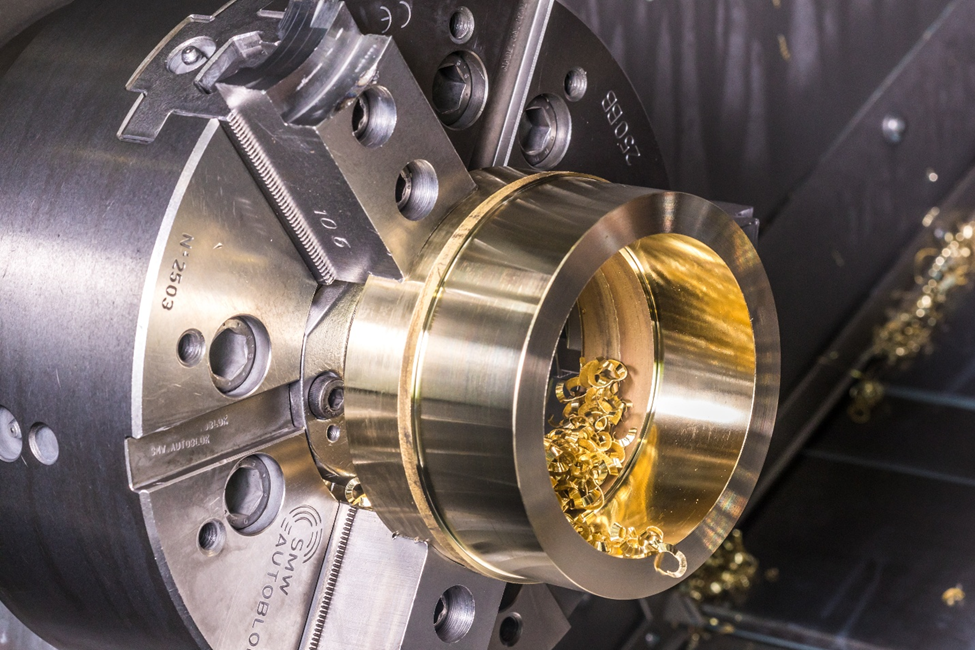
*Freshly machined AMPCO® Aluminum Bronze bushing*
### Advantages of AMPCO® Aluminum Bronze in Reducing Downtime
AMPCO aluminum bronzes, such as [**AMPCO® 45**](https://www.ampcometal.com/products/ampco-aluminium-bronze/ampco-45/) and [**AMPCO® M4**](https://www.ampcometal.com/products/ampco-aluminium-bronze/ampco-m4/), are engineered to perform reliably in environments where conventional materials quickly degrade. Their metallurgical design offers a superior combination of strength, hardness, and sliding properties, key factors in minimizing surface wear and preventing unplanned maintenance.
- **AMPCO® 45** provides balanced mechanical properties, with hardness around 228 HBW and tensile strength exceeding 800 MPa. Its uniform grain structure supports stable sliding performance, making it ideal for bushings, wear plates, and guiding elements operating under moderate to high loads.
- **AMPCO® M4** is designed for extreme service conditions, offering hardness up to 300 HBW and tensile strength up to 1000 MPa. It withstands severe contact stress and abrasive motion, maintaining dimensional stability even during long production cycles.
In comparison to standard bronzes or steels, AMPCO aluminum bronzes offer:
- **Extended component life** through superior resistance to galling, scoring, and deformation.
- **Lower maintenance frequency** thanks to better dimensional stability under high pressure and temperature.
- **Improved operational efficiency** with smoother motion and reduced friction losses.
By integrating these alloys into wear-critical components, manufacturers can reduce downtime, extend maintenance intervals, and achieve consistent production performance over longer operational periods.
### Final Thoughts
Downtime caused by wear is one of the most significant obstacles to maintaining continuous production efficiency. Aluminum bronze alloys provide a proven solution by combining hardness, strength, and stability under sliding or impact conditions. AMPCO® 45 and AMPCO® M4 demonstrate how advanced copper-based materials can extend service life, maintain precision, and minimize interruptions in demanding industrial environments.
For professionals seeking deeper technical insights into wear behavior and alloy performance, visit the [**AMPCO Academy**](https://academy.ampcometal.com/?hsLang=en)to explore specialized articles and case-based studies.
To access detailed mechanical data, performance comparisons, and practical application guidelines, download the full technical paper *“Improving Wear Resistance with High-Performance Copper Alloys.”*
*[](https://academy.ampcometal.com/landing-page-wear-resistance-2025?hsLang=en)*
*[](https://academy.ampcometal.com/hs/cta/wi/redirect?encryptedPayload=AVxigLJDUJDJ8%2FtXR0n58n4qWlsNH50onrHi1PWSP3MgRovZl1zblNZJ0yecg2Yx0no9pKQS1HCMZtkH0ePN2cnyYDXhf7R6FiSVBwR%2Bl9cm%2BDJZDBObfFsdoLwAsWd0Uqd8NSN7ZtIa13l%2BWW9HD7tOUDWEkw%2BKdfBc8eNdw0aDuZzAT%2BTFrV%2FXStoYUZ2lHduM3ANsZq%2BZFqM70tKFEXgk7Hriwvs%3D&webInteractiveContentId=199253833889&portalId=5331421&hsLang=en)*
---
[](https://cta-redirect.hubspot.com/cta/redirect/5331421/8da01823-dd9b-42be-91b8-c4efd4d4c1ea)
-
-
-
-
- [Terms of use](https://www.ampcometal.com/terms-of-use/)
- [Privacy](https://www.ampcometal.com/privacy/)
- [Links](https://www.ampcometal.com/links/)
- [Sitemap](https://www.ampcometal.com/sitemap/)
- [Code of ethics and conduct](https://www.ampcometal.com/documents/CODE-of-ETHICS-and-CONDUCT.pdf)
© 2026 AMPCO METAL