
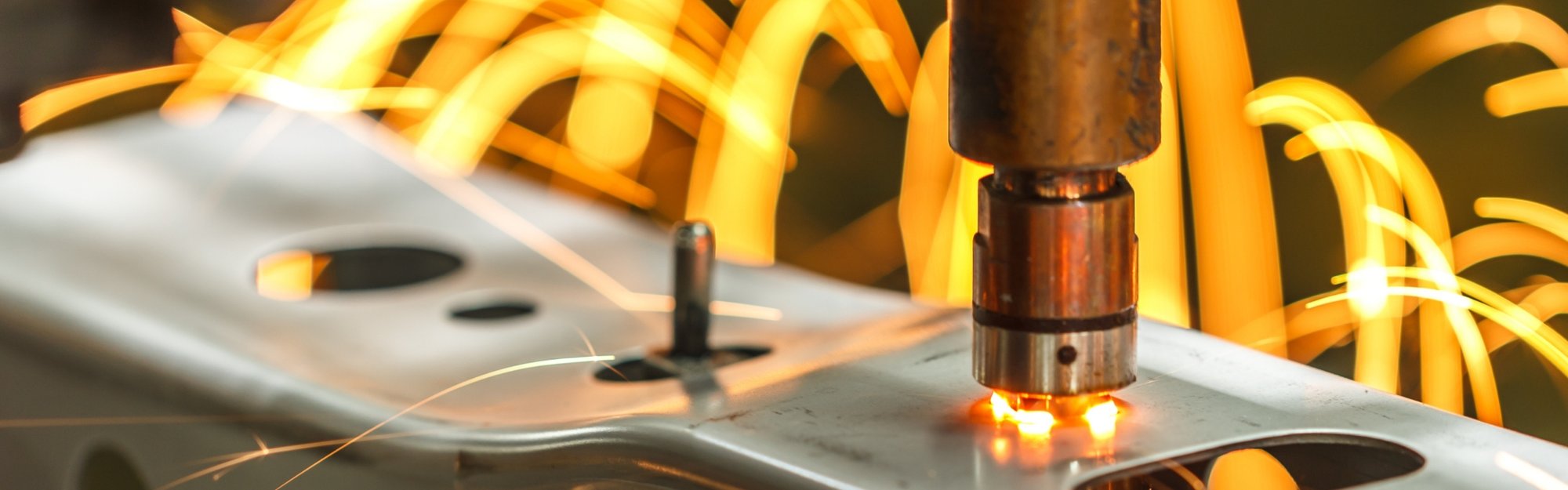
Resistance welding delivers fast, repeatable joining for high-volume production, but results depend on tight control of current, time, force, and electrode condition. This overview explains the core processes and variables.
Why Resistance Welding Is a Controlled Process
Resistance welding joins metal parts by applying force and electrical current through copper-based electrodes. Electrical resistance at the contact surfaces generates heat, and the joint forms under pressure. Since the heat is created at the interface, the process can deliver short cycle times and high repeatability in automated production.
At the same time, resistance welding is sensitive to variation. Weld current, weld time, electrode force, and the condition of the contact surfaces determine how much heat is generated and where it concentrates. Electrode wear and cooling also influence stability over long runs. This article breaks down the main resistance welding processes and the key variables that drive consistent results.
What Is Resistance Welding and Where It’s Used
Resistance welding is a group of joining processes where heat is generated by electrical resistance at the interface between two metal parts. Current is delivered through electrodes while a controlled force clamps the parts together. The goal is simple: concentrate heat at the intended joint, form a consistent weld, and do it repeatably over thousands or millions of cycles.
It’s widely used in high-volume manufacturing because it can be automated, monitored, and repeated with tight cycle times. You’ll find resistance welding in automotive body-in-white and closures, appliance and HVAC assemblies, battery and electrical components, tube and wire products, and general sheet-metal fabrication. In most of these applications, the parts are thin to medium thickness, production rates are high, and consistent weld quality matters as much as speed.
Main Resistance Welding Processes
Resistance welding includes several process types, each suited to specific joint geometries, production rates, and quality requirements. The common principle stays the same, but the way force and current are applied changes based on the application.
- Spot welding: Two electrodes clamp overlapping sheets and deliver current in a short pulse, forming a localized weld nugget at the interface. It’s widely used in high-volume sheet metal assembly.
- Seam welding: A continuous or overlapping series of weld nuggets is created along a line, typically using rotating wheel electrodes. This approach is used for long joints and, in many cases, leak-tight assemblies such as tanks and housings.
- Projection welding: Current is concentrated through raised features (projections) on one part. Under force, the projections collapse and the weld forms at defined locations. It’s commonly used to attach fasteners, brackets, and formed components, and it can create multiple welds in a single cycle.
- Butt welding: Two parts are aligned end-to-end and welded at the interface. Common variants include resistance butt welding and flash butt welding. Resistance butt welding heats the joint primarily through electrical resistance while the parts are held under force, then the joint is completed with an upset action. Flash butt welding introduces controlled flashing at the interface to generate heat quickly, followed by an upset that forges the joint. Both methods are used for rods, wires, tubes, and profiles when an end-to-end joint with consistent strength and repeatability is required.
- Crosswire welding: Intersecting wires are welded at their crossing points using shaped electrodes that apply force and current locally. It’s widely used for wire products such as grids, cages, and mesh parts.
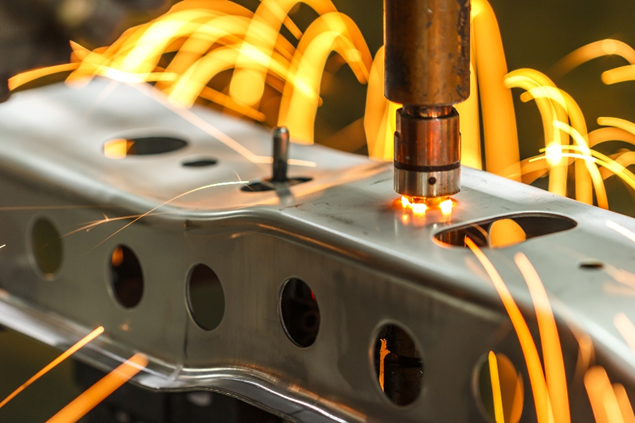
Resistance spot welding of a perforated part
Key Variables That Control Results
Resistance welding looks simple from the outside, but weld consistency is built on a small set of variables that must stay stable from part to part. When any one of them drifts, the process may still “make a weld,” but quality, appearance, and electrode life can change quickly.
- Weld current: Current is the main driver of heat generation at the joint. Too little current can lead to weak or incomplete welds. Too much current increases the risk of expulsion, surface damage, and accelerated electrode wear.
- Weld time: Time controls how long current is applied. Short times can reduce heat input and help limit marking but may not fully form the weld nugget. Longer times increase total heat input and can improve fusion but also raise the risk of overheating and inconsistency if conditions vary.
- Electrode force: Force sets the real contact area between the parts and between the electrodes and the workpiece. It affects contact resistance, current density, and how the molten zone is contained. Too little force often increases expulsion and instability. Too much force can reduce resistance at the interface and make it harder to generate heat where it’s needed.
- Contact condition and surface state: Oils, coatings, oxides, scale, and surface roughness change contact resistance. This can shift where heat is generated and make weld strength less predictable, especially when material batches or upstream processes vary.
- Electrode geometry and condition: Tip shape, alignment, and surface condition influence current density and force distribution. As electrodes wear, mushroom, or pick up material, the effective contact area changes, which can reduce weld consistency and increase marking.
- Electrode material selection: Electrode materials influence electrical and thermal conductivity, hot hardness, and resistance to deformation and pickup. In many resistance welding setups, high-copper alloys such as AMPCOLOY® are used for electrodes and electrode components to support stable current transfer and efficient heat removal, helping maintain consistent performance over long production runs.
- Cooling and heat removal: Stable cooling helps keep electrodes and tooling within a controlled temperature range. Poor cooling can cause electrode softening, faster wear, and drift in weld results over long production runs.
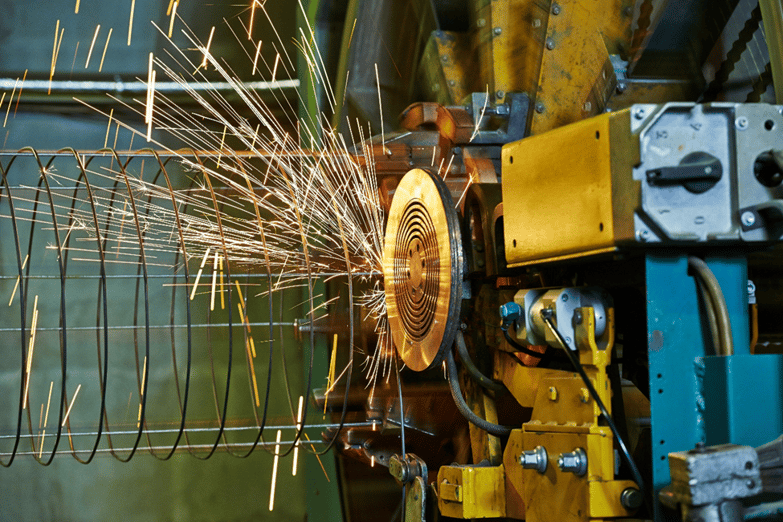
Resistance crosswire welding of a steel mesh
Final Thoughts
Resistance welding delivers speed and repeatability, but consistent results come from control. When current, time, force, contact conditions, cooling, and electrode selection stay stable, weld quality is easier to maintain and electrode life becomes more predictable. That’s why even small improvements in setup discipline and material choice can make a measurable difference in production.
If you want to go deeper into resistance welding fundamentals and practical process optimization, explore more technical articles on the AMPCO Academy, where we share application-focused insights for engineers, technicians, and manufacturing teams.
