---
title: What’s Changed in Steel Tube Bending and Why It Matters
description: Explore how steel tube bending evolved, from manual methods to CNC systems, and why material choice was just as crucial as tools and methods.
image: https://academy.ampcometal.com/hubfs/Blog/shutterstock_2081051428.jpg
---
[](https://academy.ampcometal.com/)
- Products
- AMPCO® Aluminium Bronze
- [AMPCO® 8](https://www.ampcometal.com/products/ampco-aluminum-bronze/ampco-8/)
- [AMPCO® 15](https://www.ampcometal.com/products/ampco-aluminum-bronze/ampco-15/)
- [AMPCO® 18](https://www.ampcometal.com/products/ampco-aluminum-bronze/ampco-18/)
- [AMPCO® 18.136](https://www.ampcometal.com/products/ampco-aluminum-bronze/ampco-18-136/)
- [AMPCO® 18.22](https://www.ampcometal.com/products/ampco-aluminum-bronze/ampco-18-22//)
- [AMPCO® 18.23](https://www.ampcometal.com/products/ampco-aluminum-bronze/ampco-18-23/)
- [AMPCO® 21](https://www.ampcometal.com/products/ampco-aluminum-bronze/ampco-21/)
- [AMPCO® 22](https://www.ampcometal.com/products/ampco-aluminum-bronze/ampco-22/)
- [AMPCO® 25](https://www.ampcometal.com/products/ampco-aluminum-bronze/ampco-25/)
- [AMPCO® 26](https://www.ampcometal.com/products/ampco-aluminum-bronze/ampco-26/)
- [AMPCO® 45](https://www.ampcometal.com/products/ampco-aluminum-bronze/ampco-45/)
- [AMPCO® M4](https://www.ampcometal.com/products/ampco-aluminum-bronze/ampco-m4/)
- AMPCOLOY® High Copper Alloy
- [AMPCOLOY® 83](https://www.ampcometal.com/products/ampcoloy-high-copper-alloy/ampcoloy-83/)
- [AMPCOLOY® 88](https://www.ampcometal.com/products/ampcoloy-high-copper-alloy/ampcoloy-88/)
- [AMPCOLOY® 89](https://www.ampcometal.com/products/ampcoloy-high-copper-alloy/ampcoloy-89/)
- [AMPCOLOY® 91](https://www.ampcometal.com/products/ampcoloy-high-copper-alloy/ampcoloy-91/)
- [AMPCOLOY® 95](https://www.ampcometal.com/products/ampcoloy-high-copper-alloy/ampcoloy-95/)
- [AMPCOLOY® 940](https://www.ampcometal.com/products/ampcoloy-high-copper-alloy/ampcoloy-940/)
- [AMPCOLOY® 944](https://www.ampcometal.com/products/ampcoloy-high-copper-alloy/ampcoloy-944/)
- [AMPCOLOY® 972](https://www.ampcometal.com/products/ampcoloy-high-copper-alloy/ampcoloy-972/)
- [Cu-W Sintered](https://www.ampcometal.com/products/ampcoloy-high-copper-alloy/cu-w-sintered)
- AMS Alloys
- [AMS 4590](https://www.ampcometal.com/products/ams-alloys/ams-4590/)
- [AMS 4640](https://www.ampcometal.com/products/ams-alloys/ams-4640/)
- [AMS 4880](https://www.ampcometal.com/products/ams-alloys/ams-4880/)
- [AMS 4881](https://www.ampcometal.com/products/ams-alloys/ams-4881/)
- [Standard Alloys](https://www.ampcometal.com/products/standard-alloys/)
- [Welding Wire](https://www.ampcowelding.com/)
- [Safety Tools](https://www.safetytools.com/)
- Solutions
- Applications
- [Wear Resistance](https://www.ampcometal.com/applications/wear-resistance/)
- [Corrosion Resistance](https://www.ampcometal.com/applications/corrosion-resistance/)
- [Metal Forming & Tooling](https://www.ampcometal.com/applications/metal-forming/)
- [Die Casting](https://www.ampcometal.com/applications/die-casting/)
- [Plastic Processing](https://www.ampcometal.com/applications/plastic-processing/)
- [Resistance Welding](https://www.ampcometal.com/applications/resistance-welding/)
- Industries
- [Aerospace](https://www.ampcometal.com/industries/aerospace/)
- [Automotive](https://www.ampcometal.com/industries/automotive/)
- [General Engineering](https://www.ampcometal.com/industries/general-engineering/)
- [Marine](https://www.ampcometal.com/industries/marine/)
- [Metal Forming](https://www.ampcometal.com/industries/metal-forming/)
- [Oil, Gas & Chemical](https://www.ampcometal.com/industries/oil-gas-chemical/)
- [Plastic Processing](https://www.ampcometal.com/industries/plastic-processing/)
- [Resistance Welding](https://www.ampcometal.com/industries/resistance-welding/)
- [Steel](https://www.ampcometal.com/industries/steel)
- [Hydrogen](https://www.ampcometal.com/industries/hydrogen)
- [Luxury](https://www.ampcometal.com/industries/luxury)
- [Finished Machine Parts](https://www.ampcometal.com/finished-machined-parts/)
- [Additive Manufacturing](https://www.ampcometal.com/additive-manufacturing/)
- [Technical Consulting](https://www.ampcometal.com/technical-consulting/)
- Who We Are
- [Sustainability](https://www.ampcometal.com/sustainability/)
- [Sustainability Management](https://www.ampcometal.com/sustainability/sustainability-management/)
- [Environment](https://www.ampcometal.com/sustainability/environment/)
- [Social](https://www.ampcometal.com/sustainability/social/)
- [Governance](https://www.ampcometal.com/sustainability/governance/)
- [Future Goals](https://www.ampcometal.com/sustainability/furure-goals/)
- [Our History](https://www.ampcometal.com/our-history/)
- [About Us](https://www.ampcometal.com/about-us/)
- [Working at AMPCO](https://www.ampcometal.com/working-at-ampco)
- [Working with AMPCO](https://www.ampcometal.com/working-with-ampco)
- Technical Hub
- Technical Data
- [Application Datasheets](https://www.ampcometal.com/application-datasheets/)
- [Technical Datasheets](https://www.ampcometal.com/technical-datasheets/)
- [Microcast® Technology](https://www.ampcometal.com/mirocast-technology/)
- [Machining Recommendations](https://www.ampcometal.com/machining-recommendations/)
- Documentation
- [Safety Data Sheets](https://www.ampcometal.com/safety-data-sheets/)
- [Certifications](https://www.ampcometal.com/certifications/)
- [Food Approval Data](https://www.ampcometal.com/food-approval-data/)
- [Sales Terms and Conditions](https://www.ampcometal.com/sales-terms-and-conditions/)
- [ATEX Certification Data](https://www.ampcometal.com/atex-certification-data/)
- [Product Selection Tool](https://www.ampcometal.com/product-selection-tool/)
- [Stock Availability](https://www.ampcometal.com/ssd/)
- [Academy](https://academy.ampcometal.com/)
- [Contact](https://www.ampcometal.com/contact-us/#contact-us)
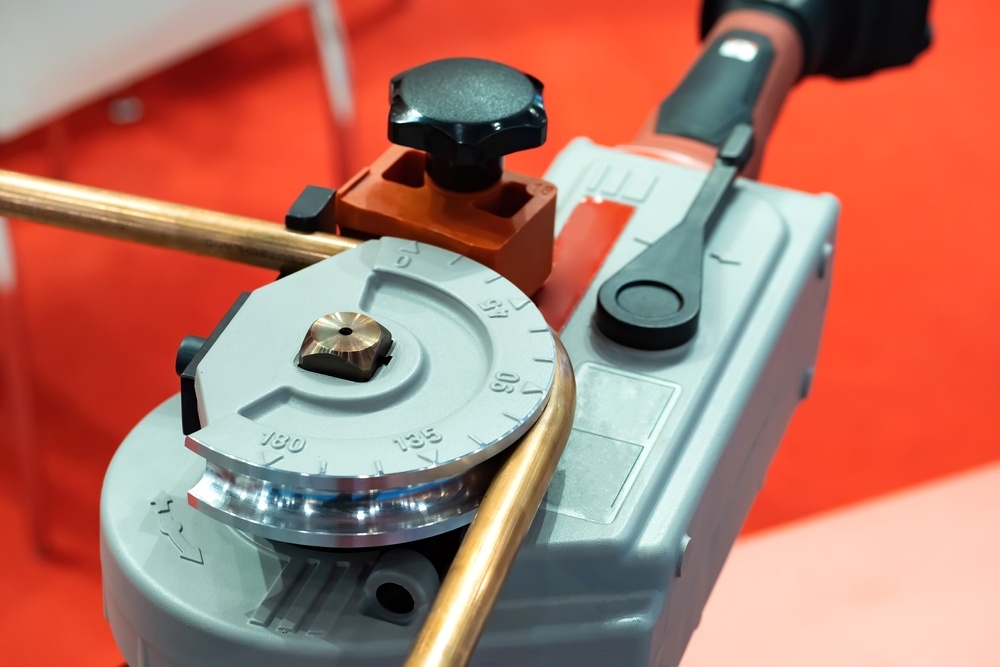
# What’s Changed in Steel Tube Bending and Why It Matters
Jul 25, 2025 1:53:03 PM | Written by [AMPCO METAL](https://academy.ampcometal.com/author/ampco-metal)
- [Tweet](https://twitter.com/share)
**Steel tube bending used to be done by hand. Today, it relies on accurate and controlled machines. Understanding how the process has changed gives a clearer look at modern manufacturing methods and the materials that support them.**
Steel tube bending is a key part of many industrial processes, from automotive parts to structural components. Over time, the tools, machines, and techniques used to bend steel have changed significantly. Many of these improvements made it possible to bend stronger materials with better results. At the same time, they’ve also introduced new challenges in quality control and material selection.
Understanding how tube bending has evolved is useful not only for engineers and operators, but for anyone interested in how modern industry works. It’s a process that shows how precise improvements and smart material choices can make a real difference in outcomes.
[](https://cta-redirect.hubspot.com/cta/redirect/5331421/fbd6451d-79f7-4612-af4b-d5dbb8d17bd4)
### From Heated Pipes to Manual Bending Tools
Before steel [tube bending](https://www.ampcometal.com/industries/metal-processing/) became an industrial process, it started with very basic methods. In the early days, pipes were usually heated over an open flame and bent manually. This was more of a craft than a precise manufacturing method. It was often carried out by blacksmiths or using simple tools and a lot of force.
Some techniques used heat and tightly packed sand to reduce wrinkling. Others relied on the usage of large amounts of oil. Sometimes it was used as a filler, sometimes to evenly heat the entire length of tubing during bending, or to just provide lubrication. In many cases, their only option was pure strength.
These early methods were slow, difficult, and hard to control. Accuracy was limited, and maintaining constant production was nearly impossible. But for the time, it worked well enough to get basic results.
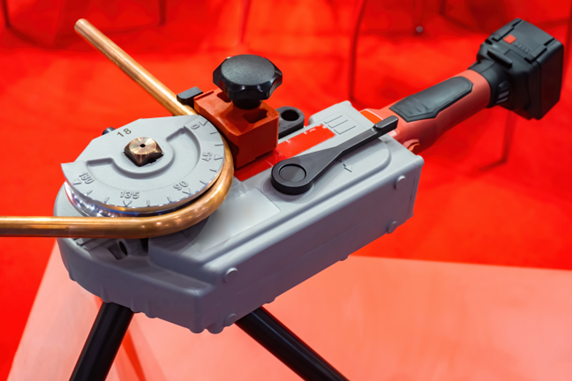*Simple mechanical tube bending tool with a small motor*
### How Precision Became Essential in Steel Tube Bending
As manufacturing advanced, so did the need for more accurate and repeatable [tube bending](https://www.ampcometal.com/applications/metal-forming/). The introduction of new materials, especially strong metals like stainless steel, meant that older, heat-based methods were no longer enough. This led to the development of cold bending processes, where steel tubes are shaped without heating, using controlled force and specialized tools.
Over time, machines replaced manual labor. Mechanical benders were followed by hydraulic systems, and eventually by CNC-controlled electrical equipment. These systems made it possible to produce complex bends with a high degree of accuracy, even in high-strength steels. As steel tube bending became more precise, it also became more demanding. Smaller tolerances, tighter bend radii, and cleaner finishes became standard, raising the requirements for what materials and machines had to deliver.
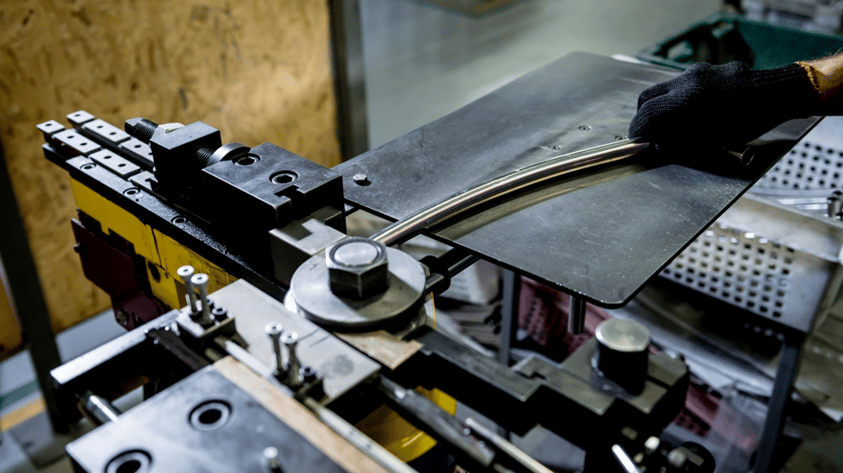*A modern rotary draw bending machine for steel tube bending*
### What Today’s Demands Mean for Materials and Machinery
Modern manufacturing puts high expectations on steel tube bending. It’s not enough to just form a tube to the right shape. It must be done quickly, accurately, without defects or too much waste. As materials have become stronger and more specialized, bending them without cracking, wrinkling, or losing shape has become more difficult.
That’s why selecting the right tools and [materials](https://www.ampcometal.com/products/ampco-aluminium-bronze/) is just as important as the bending machine itself. The parts that come into direct contact with the tube, like mandrels, wiper dies, or clamping tools, need to offer the right balance of hardness, wear resistance, and surface finish. If they don’t, the result can be excessive friction, premature tool wear, or poor bend quality.
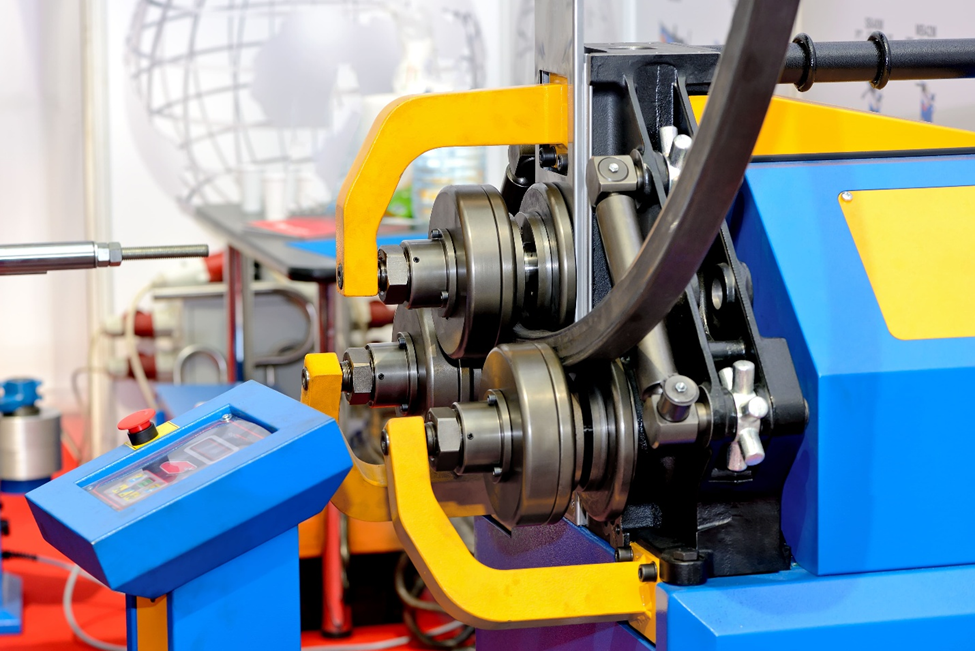*High precision setup for bending rectangular tubes*
### Final Thoughts
Steel tube bending has come a long way, from basic hand tools to high-precision systems. But with progress comes complexity, and success now doesn’t depend just on using the right tools and techniques, but also selecting the proper materials.
To learn more about how material choice affects bending results, and how AMPCO alloys support better outcomes, you can download our technical paper on troubleshooting common tube bending issues or read more in our [academy](https://academy.ampcometal.com/?hsLang=en).
[****](https://academy.ampcometal.com/technical-paper-troubleshooting-tube-bending-issues?hsLang=en)
[](https://cta-redirect.hubspot.com/cta/redirect/5331421/9c07b987-d76f-4dff-b923-eb93787e0a09)
---
[](https://cta-redirect.hubspot.com/cta/redirect/5331421/917a2a2e-3d54-4cea-a66a-c33b808f27d7)
-
-
-
-
- [Terms of use](https://www.ampcometal.com/terms-of-use/)
- [Privacy](https://www.ampcometal.com/privacy/)
- [Links](https://www.ampcometal.com/links/)
- [Sitemap](https://www.ampcometal.com/sitemap/)
- [Code of ethics and conduct](https://www.ampcometal.com/documents/CODE-of-ETHICS-and-CONDUCT.pdf)
© 2026 AMPCO METAL