---
title: Four Common Causes of Cycle Time Inefficiency | AMPCO METAL
description: Cycle time inefficiency in molding, die casting, forming, and machining traces back to four common causes. Here’s how to spot each one
image: https://academy.ampcometal.com/hubfs/Title%20picture_Beige%20Console%20Shell%20Ejecting%20from%20Copper%20Mold%20(1)-2.png
---
[](https://academy.ampcometal.com/)
- Products
- AMPCO® Aluminium Bronze
- [AMPCO® 8](https://www.ampcometal.com/products/ampco-aluminum-bronze/ampco-8/)
- [AMPCO® 15](https://www.ampcometal.com/products/ampco-aluminum-bronze/ampco-15/)
- [AMPCO® 18](https://www.ampcometal.com/products/ampco-aluminum-bronze/ampco-18/)
- [AMPCO® 18.136](https://www.ampcometal.com/products/ampco-aluminum-bronze/ampco-18-136/)
- [AMPCO® 18.22](https://www.ampcometal.com/products/ampco-aluminum-bronze/ampco-18-22//)
- [AMPCO® 18.23](https://www.ampcometal.com/products/ampco-aluminum-bronze/ampco-18-23/)
- [AMPCO® 21](https://www.ampcometal.com/products/ampco-aluminum-bronze/ampco-21/)
- [AMPCO® 22](https://www.ampcometal.com/products/ampco-aluminum-bronze/ampco-22/)
- [AMPCO® 25](https://www.ampcometal.com/products/ampco-aluminum-bronze/ampco-25/)
- [AMPCO® 26](https://www.ampcometal.com/products/ampco-aluminum-bronze/ampco-26/)
- [AMPCO® 45](https://www.ampcometal.com/products/ampco-aluminum-bronze/ampco-45/)
- [AMPCO® M4](https://www.ampcometal.com/products/ampco-aluminum-bronze/ampco-m4/)
- AMPCOLOY® High Copper Alloy
- [AMPCOLOY® 83](https://www.ampcometal.com/products/ampcoloy-high-copper-alloy/ampcoloy-83/)
- [AMPCOLOY® 88](https://www.ampcometal.com/products/ampcoloy-high-copper-alloy/ampcoloy-88/)
- [AMPCOLOY® 89](https://www.ampcometal.com/products/ampcoloy-high-copper-alloy/ampcoloy-89/)
- [AMPCOLOY® 91](https://www.ampcometal.com/products/ampcoloy-high-copper-alloy/ampcoloy-91/)
- [AMPCOLOY® 95](https://www.ampcometal.com/products/ampcoloy-high-copper-alloy/ampcoloy-95/)
- [AMPCOLOY® 940](https://www.ampcometal.com/products/ampcoloy-high-copper-alloy/ampcoloy-940/)
- [AMPCOLOY® 944](https://www.ampcometal.com/products/ampcoloy-high-copper-alloy/ampcoloy-944/)
- [AMPCOLOY® 972](https://www.ampcometal.com/products/ampcoloy-high-copper-alloy/ampcoloy-972/)
- [Cu-W Sintered](https://www.ampcometal.com/products/ampcoloy-high-copper-alloy/cu-w-sintered)
- AMS Alloys
- [AMS 4590](https://www.ampcometal.com/products/ams-alloys/ams-4590/)
- [AMS 4640](https://www.ampcometal.com/products/ams-alloys/ams-4640/)
- [AMS 4880](https://www.ampcometal.com/products/ams-alloys/ams-4880/)
- [AMS 4881](https://www.ampcometal.com/products/ams-alloys/ams-4881/)
- [Standard Alloys](https://www.ampcometal.com/products/standard-alloys/)
- [Welding Wire](https://www.ampcowelding.com/)
- [Safety Tools](https://www.safetytools.com/)
- Solutions
- Applications
- [Wear Resistance](https://www.ampcometal.com/applications/wear-resistance/)
- [Corrosion Resistance](https://www.ampcometal.com/applications/corrosion-resistance/)
- [Metal Forming & Tooling](https://www.ampcometal.com/applications/metal-forming/)
- [Die Casting](https://www.ampcometal.com/applications/die-casting/)
- [Plastic Processing](https://www.ampcometal.com/applications/plastic-processing/)
- [Resistance Welding](https://www.ampcometal.com/applications/resistance-welding/)
- Industries
- [Aerospace](https://www.ampcometal.com/industries/aerospace/)
- [Automotive](https://www.ampcometal.com/industries/automotive/)
- [General Engineering](https://www.ampcometal.com/industries/general-engineering/)
- [Marine](https://www.ampcometal.com/industries/marine/)
- [Metal Forming](https://www.ampcometal.com/industries/metal-forming/)
- [Oil, Gas & Chemical](https://www.ampcometal.com/industries/oil-gas-chemical/)
- [Plastic Processing](https://www.ampcometal.com/industries/plastic-processing/)
- [Resistance Welding](https://www.ampcometal.com/industries/resistance-welding/)
- [Steel](https://www.ampcometal.com/industries/steel)
- [Hydrogen](https://www.ampcometal.com/industries/hydrogen)
- [Luxury](https://www.ampcometal.com/industries/luxury)
- [Finished Machine Parts](https://www.ampcometal.com/finished-machined-parts/)
- [Additive Manufacturing](https://www.ampcometal.com/additive-manufacturing/)
- [Technical Consulting](https://www.ampcometal.com/technical-consulting/)
- Who We Are
- [Sustainability](https://www.ampcometal.com/sustainability/)
- [Sustainability Management](https://www.ampcometal.com/sustainability/sustainability-management/)
- [Environment](https://www.ampcometal.com/sustainability/environment/)
- [Social](https://www.ampcometal.com/sustainability/social/)
- [Governance](https://www.ampcometal.com/sustainability/governance/)
- [Future Goals](https://www.ampcometal.com/sustainability/furure-goals/)
- [Our History](https://www.ampcometal.com/our-history/)
- [About Us](https://www.ampcometal.com/about-us/)
- [Working at AMPCO](https://www.ampcometal.com/working-at-ampco)
- [Working with AMPCO](https://www.ampcometal.com/working-with-ampco)
- Technical Hub
- Technical Data
- [Application Datasheets](https://www.ampcometal.com/application-datasheets/)
- [Technical Datasheets](https://www.ampcometal.com/technical-datasheets/)
- [Microcast® Technology](https://www.ampcometal.com/mirocast-technology/)
- [Machining Recommendations](https://www.ampcometal.com/machining-recommendations/)
- Documentation
- [Safety Data Sheets](https://www.ampcometal.com/safety-data-sheets/)
- [Certifications](https://www.ampcometal.com/certifications/)
- [Food Approval Data](https://www.ampcometal.com/food-approval-data/)
- [Sales Terms and Conditions](https://www.ampcometal.com/sales-terms-and-conditions/)
- [ATEX Certification Data](https://www.ampcometal.com/atex-certification-data/)
- [Product Selection Tool](https://www.ampcometal.com/product-selection-tool/)
- [Stock Availability](https://www.ampcometal.com/ssd/)
- [Academy](https://academy.ampcometal.com/)
- [Contact](https://www.ampcometal.com/contact-us/#contact-us)
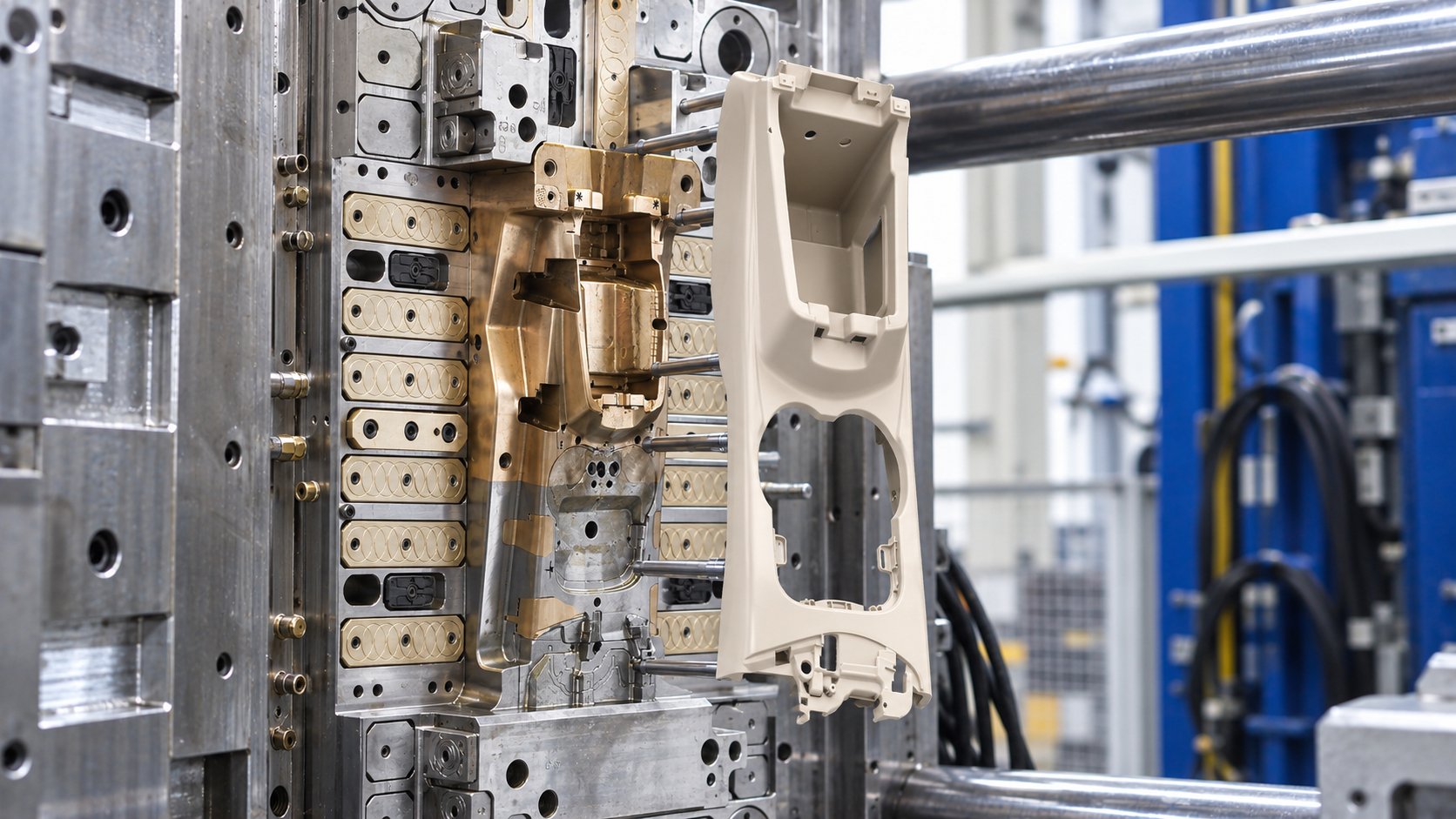
# Common Causes of Cycle Time Inefficiency (and How to Spot Them)
Oct 26, 2026, 2:48:45 PM | Written by [AMPCO METAL](https://academy.ampcometal.com/author/ampco-metal)
- [Tweet](https://twitter.com/share)
Cycle time inefficiency is the gap between the cycle time a process should achieve and the cycle time it actually achieves.
The gap is easy to measure, but its cause is not, so teams often blame the machine or the operator first.The wrong fix can add cost and downtime without solving the underlying problem. This article looks at the common causes across manufacturing processes in general, including injection molding, die casting, forming, and machining.**It explores:**
- What is cycle time inefficiency, and why is it a symptom rather than a root cause?
- What are the four common causes (heat transfer limits, wear, secondary steps, and inherited process settings), and in which processes does each matter most?
- How can you identify which cause of cycle time inefficiency affects your process?
### **Why Is Cycle Time Inefficiency a Symptom, Not a Diagnosis?**
In molding, die casting, forming, and machining, cycle time covers every step the process demands: loading, processing, cooling or curing, ejection or unloading, and reset.
In molding and die casting, cooling usually takes the largest share. In forming and machining, tool condition, process parameters, and handling matter more.
Cycle time inefficiency rarely has one cause, and each cause calls for a different correction. Treating the symptom without finding the source often shifts the problem rather than solving it.
Longer cycles raise cost per part and lower equipment utilization, which can push capacity investments forward.
A few seconds per cycle add up quickly across shifts, which is why it matters to know the causes and how to spot them.
### **What Are the Four Common Causes of Cycle Time Inefficiency?**
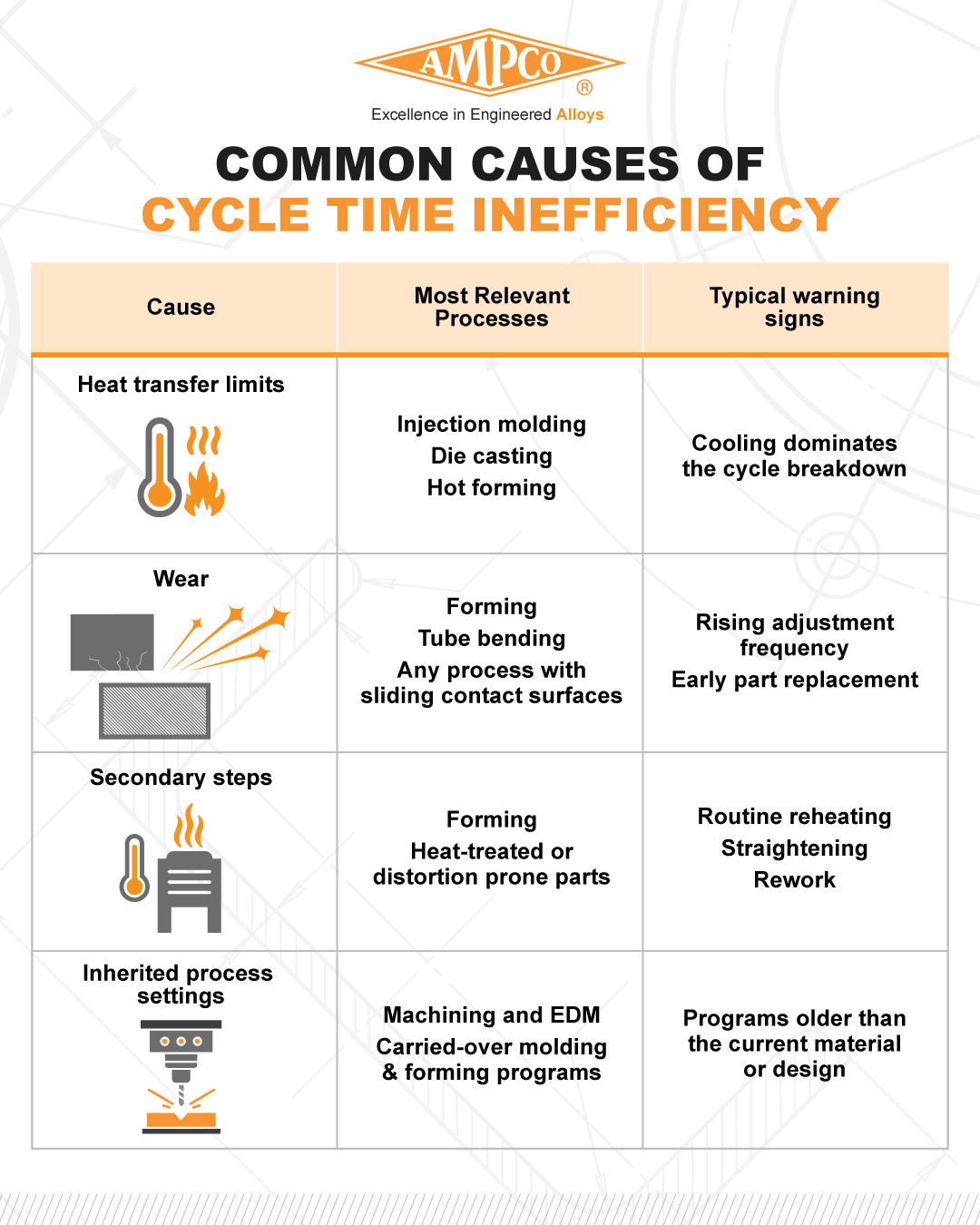
The table below summarizes where each cause appears most often and what usually signals it. The sections that follow explain each one.
### **Cause 1: Heat Transfer Limits, Not Machine Speed**
**Most relevant to: injection molding, die casting, and hot forming.**
In thermal processes, many cycles are not limited by how fast the equipment can move. They are limited by how fast heat can move.
In injection molding, die casting, and hot forming, a part cannot be ejected or transferred until it has cooled to a stable temperature.
The machine can open, close, and index quickly, but it still has to wait for the tool to extract enough heat from the part.
Cooling is a common source of cycle time inefficiency in these processes because it limits the gains from other optimizations.
Published injection molding data from AMPCO METAL shows the effect. In tests where only the core material changed, an H13 steel core needed about 9.6 seconds of overall cycle time for warp-free parts, including about 5.1 seconds of cooling.
An [AMPCOLOY® 940](https://www.ampcometal.com/products/ampcoloy-high-copper-alloy/ampcoloy-940/?utm_source=ampco_academy&utm_medium=Blog&utm_campaign=Injection+molding_2026&utm_id=09_2026#product-description)core cut cooling to about 3.3 seconds and the overall cycle to about 7.8 seconds. Heat transfer was the limiting factor, not the machine.
Typical signs are a cycle dominated by cooling, hot spots in cores or thick sections, and parts that warp when cooling time is shortened.
This cause dominates only where a thermal phase controls the cycle. In cold forming and machining, the loss usually comes from the causes below.
### **Cause 2: Wear That Accumulates Faster Than Expected**
**Most relevant to: metal forming and tube bending, and any process that relies on guides, bushings, slides, or other sliding contact surfaces, including molds and dies.**
Unlike heat transfer, wear affects almost every process with moving contact surfaces. It rarely stops a line all at once. Instead, it builds gradually on tooling, guides, bushings, and other contact surfaces.
As these surfaces lose dimension or finish, the process needs more force, settings drift, operators adjust more often, and components reach their replacement point sooner than planned.
On paper, nothing has changed. In practice, each extra adjustment, inspection, and changeover adds time that never appears in the nominal cycle.
Because the cost shows up as reduced availability rather than a single failure, wear is easy to underestimate. Material selection influences how quickly wear progresses.
In heavy-duty sliding applications such as steel mills, AMPCO METAL’s published data for its AMPCO® aluminum bronzes cites 20 to 40 percent higher wear characteristics, a difference that directly affects how often a line stops for replacement or adjustment.
Typical signs include more frequent adjustments, steadily rising force or pressure, part dimensions that drift between changeovers, and components replaced before their planned service interval.
### **Cause 3: Secondary Steps That Hide Inside the Process**
**Most relevant to: forming, especially of materials that need heat treatment after forming, and parts that are prone to distortion.**
Some steps that teams count as part of “the cycle” are not core process steps at all.
Reheating, stress relief, straightening, and distortion correction often enter the routing to compensate for an upstream mismatch, such as a material that does not suit the forming method or a part geometry that reacts poorly to heat.
Over time, these steps become routine and nobody questions them. Because each one appears justified on its own, the real cycle grows while the process plan looks stable.
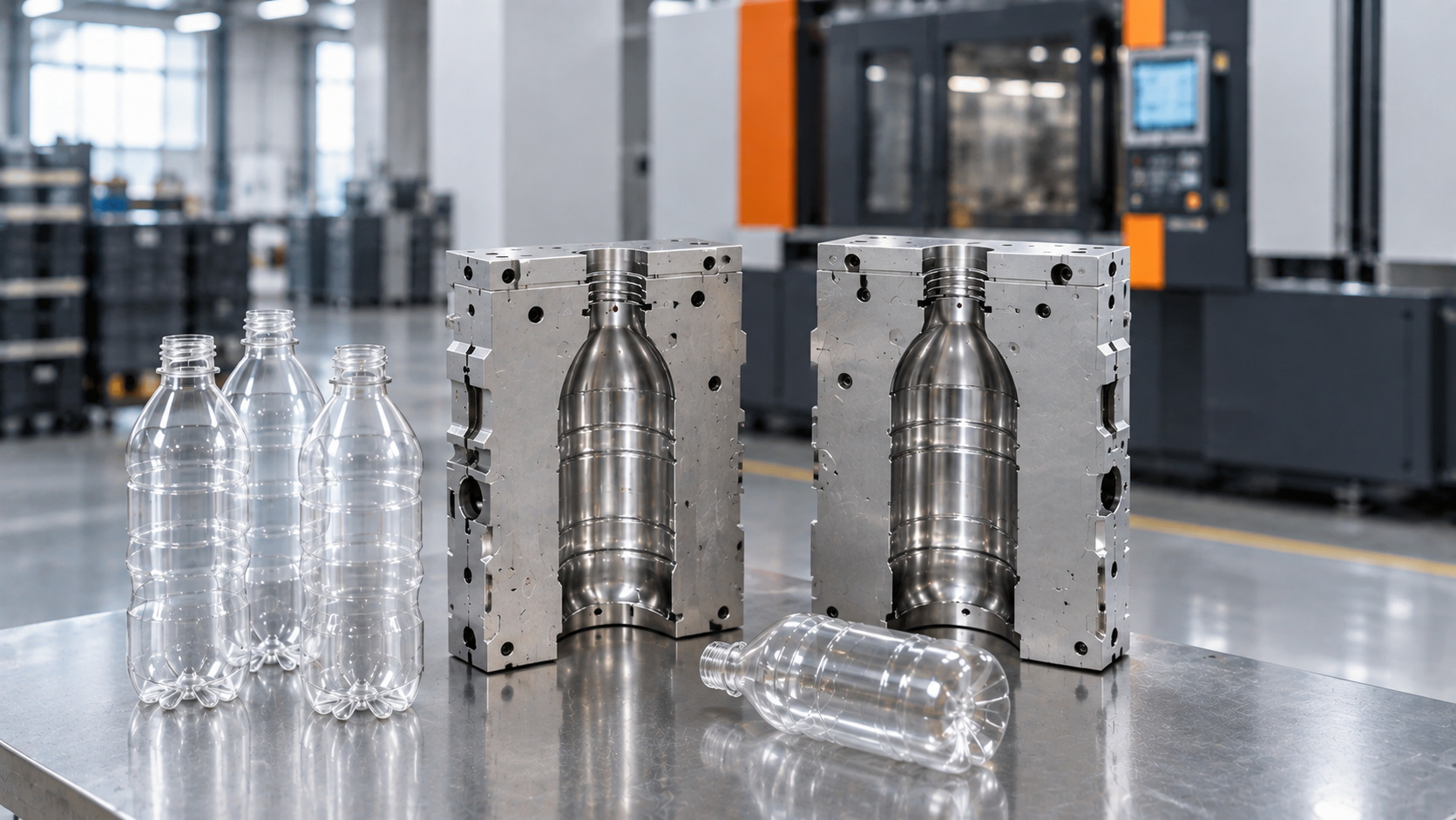
Forming offers a clear illustration. Some materials cannot be formed cold, and heating them degrades their mechanical properties, so a full heat treatment must follow.
Small or thin parts may then warp or distort, adding review and rework that were never in the original plan.
Typical signs include recurring rework, routine straightening, and heat treatment added after forming. Tracing each secondary step back to its origin often reveals an upstream mismatch rather than a necessary process step.
### **Cause 4: Inherited Process Settings That No Longer Fit**
**Most relevant to: machining and EDM, as well as molding and forming programs carried over after a material, tool, or design change.**
Process settings often outlive the conditions they were written for. A program developed for a previous tool, material, or part design moves to the next job because it works well enough.
But a new material conducts heat differently, responds differently to cutting or erosion, or needs different forces, and a revised geometry changes how the part fills, cools, or releases. When the settings stay the same, the process compensates with longer cycles, more conservative parameters, or more frequent tool changes.
This type of cycle time inefficiency rarely triggers an alarm. Cycle time drifts upward slowly, and without a clear baseline, each small increase looks like normal variation.
Electrical discharge machining (EDM), widely used for mold and die components, shows how measurable the effect can be.
AMPCO METAL’s EDM guidance for its copper alloys notes that aluminum bronzes such as AMPCO® 18 can be eroded with settings similar to those used for tool steels.
High-conductivity alloys such as [AMPCOLOY® 940](https://www.ampcometal.com/products/ampcoloy-high-copper-alloy/ampcoloy-940/?utm_source=ampco_academy&utm_medium=Blog&utm_campaign=Injection+molding_2026&utm_id=09_2026#product-description) and [AMPCOLOY® 944](https://www.ampcometal.com/products/ampcoloy-high-copper-alloy/ampcoloy-944/?utm_source=ampco_academy&utm_medium=Blog&utm_campaign=Injection+molding_2026&utm_id=09_2026#product-description) erode faster but cause higher electrode wear, so they need different settings.
With settings adjusted to the material, the guidance cites an efficiency improvement of about 25 percent, and for AMPCOLOY® alloys, electrode wear reduced by a factor of three.
To identify this cause, check when each process program was last validated. Settings that predate a material, tool, or design change deserve a review.
### **How to Tell Which Cause of Cycle Time Inefficiency Applies to Your Process**
Because cycle time inefficiency is a symptom, professionals should locate its source before trying to fix it. These questions help narrow the search on your own line:
- **What type of process is it?** In molding, die casting, and hot forming, check the thermal phase first. In cold forming and machining, start with tooling condition and process settings.
- **Is the delay concentrated in one stage or spread across the whole cycle?** A delay concentrated in cooling or another thermal phase points to heat transfer. A delay spread across the cycle suggests broader causes, such as worn components or outdated settings.
- **Has tooling condition changed recently?** Rising adjustment frequency, higher required force, or drifting part dimensions indicate wear. Compare current replacement intervals with the planned ones.
- **Are secondary operations increasing?** Track how often parts need reheating, straightening, stress relief, or rework. A growing share of secondary steps usually signals an upstream mismatch rather than a process requirement.
- **Have settings been reviewed since the last material or design change?** A program that predates the current material, tool, or part geometry may no longer fit the process.
More than one answer may apply. Cycle time inefficiency often has several contributing causes, so address the largest measurable loss first, then reassess. A structured review of this kind turns a vague performance problem into a set of specific, solvable issues.
### **Conclusion**
Cycle time inefficiency rarely has one cause. It can come from slow heat extraction, accumulated wear, routine secondary steps, or outdated settings.
Process type shapes which cause is most likely, but any of them can appear in any process, and they often overlap.
Changing equipment or parameters without identifying the active cause may only shift the problem. Diagnose first, and the right fix will follow.
### **What should I check before assuming I need a different material?**
Start with the factors that are easier to correct. Confirm that process settings match the current material, tool, and part geometry. Check tooling condition and replacement intervals. Review whether secondary operations have increased. If cooling still dominates the cycle after these checks, material selection may be worth evaluating.
### **Frequently Asked Questions**
**What is cycle time inefficiency?**
Cycle time inefficiency occurs when a production cycle takes longer than the process should require. It is a symptom, usually caused by heat transfer limits, wear, secondary steps, or outdated process settings.
**Does cycle time inefficiency only affect injection molding?**
No. It also occurs in die casting, forming, and machining. Thermal limits dominate in molding and die casting, while wear, secondary steps, and settings matter more in forming and machining.
**How do you reduce cycle time inefficiency?**
Identify the active cause first, then correct it. Depending on the cause, that means improving heat extraction, reviewing contact materials, removing compensating steps at their source, or revalidating settings after a material, tool, or design change.
**How can I tell if my cycle time issue is a heat transfer problem?**
Check the cycle breakdown. If cooling dominates the cycle, or parts warp when cooling time is shortened, heat transfer is the likely cause.
**Can wear cause cycle time to increase even if nothing else in the process changed?**
Yes. Worn contact surfaces require more force, more frequent adjustments, and earlier replacement, so the time per good part increases.
**Why would a secondary step like heat treatment affect cycle time if it isn’t part of the main process?**
Each secondary step adds handling, processing, and inspection time. Heat treatment can also distort small or thin parts, which adds rework.
**Is a longer cycle time always a sign of a machine limitation?**
No. In one injection molding comparison, replacing an H13 steel core with an [AMPCOLOY® 940](https://www.ampcometal.com/products/ampcoloy-high-copper-alloy/ampcoloy-940/?utm_source=ampco_academy&utm_medium=Blog&utm_campaign=Injection+molding_2026&utm_id=09_2026#product-description) core cut overall cycle time from about 9.6 to about 7.8 seconds on the same machine.
Identifying the active cause of cycle time inefficiency depends on the specifics of each process, tool, and part. [Contact AMPCO METAL's technical team](https://www.ampcometal.com/contact-us/?utm_source=ampco_academy&utm_medium=Blog&utm_campaign=Injection+molding_2026&utm_id=09_2026) to discuss your cycle breakdown, operating conditions, tooling wear patterns, and material options for your specific application.
[](https://cta-redirect.hubspot.com/cta/redirect/5331421/8da01823-dd9b-42be-91b8-c4efd4d4c1ea)
-
-
-
-
- [Terms of use](https://www.ampcometal.com/terms-of-use/)
- [Privacy](https://www.ampcometal.com/privacy/)
- [Links](https://www.ampcometal.com/links/)
- [Sitemap](https://www.ampcometal.com/sitemap/)
- [Code of ethics and conduct](https://www.ampcometal.com/documents/CODE-of-ETHICS-and-CONDUCT.pdf)
© 2026 AMPCO METAL