---
title: "CuCrZr vs. Pure Copper: When Conductivity Alone Is Not Enough"
description: Pure copper conducts well but softens under heat and load. CuCrZr addresses this through precipitation hardening.
image: https://academy.ampcometal.com/hubfs/CuCrZr%20vs.%20Pure%20Copper%20Blog%20image-1.jpg
---
[](https://academy.ampcometal.com/)
- Products
- AMPCO® Aluminium Bronze
- [AMPCO® 8](https://www.ampcometal.com/products/ampco-aluminum-bronze/ampco-8/)
- [AMPCO® 15](https://www.ampcometal.com/products/ampco-aluminum-bronze/ampco-15/)
- [AMPCO® 18](https://www.ampcometal.com/products/ampco-aluminum-bronze/ampco-18/)
- [AMPCO® 18.136](https://www.ampcometal.com/products/ampco-aluminum-bronze/ampco-18-136/)
- [AMPCO® 18.22](https://www.ampcometal.com/products/ampco-aluminum-bronze/ampco-18-22//)
- [AMPCO® 18.23](https://www.ampcometal.com/products/ampco-aluminum-bronze/ampco-18-23/)
- [AMPCO® 21](https://www.ampcometal.com/products/ampco-aluminum-bronze/ampco-21/)
- [AMPCO® 22](https://www.ampcometal.com/products/ampco-aluminum-bronze/ampco-22/)
- [AMPCO® 25](https://www.ampcometal.com/products/ampco-aluminum-bronze/ampco-25/)
- [AMPCO® 26](https://www.ampcometal.com/products/ampco-aluminum-bronze/ampco-26/)
- [AMPCO® 45](https://www.ampcometal.com/products/ampco-aluminum-bronze/ampco-45/)
- [AMPCO® M4](https://www.ampcometal.com/products/ampco-aluminum-bronze/ampco-m4/)
- AMPCOLOY® High Copper Alloy
- [AMPCOLOY® 83](https://www.ampcometal.com/products/ampcoloy-high-copper-alloy/ampcoloy-83/)
- [AMPCOLOY® 88](https://www.ampcometal.com/products/ampcoloy-high-copper-alloy/ampcoloy-88/)
- [AMPCOLOY® 89](https://www.ampcometal.com/products/ampcoloy-high-copper-alloy/ampcoloy-89/)
- [AMPCOLOY® 91](https://www.ampcometal.com/products/ampcoloy-high-copper-alloy/ampcoloy-91/)
- [AMPCOLOY® 95](https://www.ampcometal.com/products/ampcoloy-high-copper-alloy/ampcoloy-95/)
- [AMPCOLOY® 940](https://www.ampcometal.com/products/ampcoloy-high-copper-alloy/ampcoloy-940/)
- [AMPCOLOY® 944](https://www.ampcometal.com/products/ampcoloy-high-copper-alloy/ampcoloy-944/)
- [AMPCOLOY® 972](https://www.ampcometal.com/products/ampcoloy-high-copper-alloy/ampcoloy-972/)
- [Cu-W Sintered](https://www.ampcometal.com/products/ampcoloy-high-copper-alloy/cu-w-sintered)
- AMS Alloys
- [AMS 4590](https://www.ampcometal.com/products/ams-alloys/ams-4590/)
- [AMS 4640](https://www.ampcometal.com/products/ams-alloys/ams-4640/)
- [AMS 4880](https://www.ampcometal.com/products/ams-alloys/ams-4880/)
- [AMS 4881](https://www.ampcometal.com/products/ams-alloys/ams-4881/)
- [Standard Alloys](https://www.ampcometal.com/products/standard-alloys/)
- [Welding Wire](https://www.ampcowelding.com/)
- [Safety Tools](https://www.safetytools.com/)
- Solutions
- Applications
- [Wear Resistance](https://www.ampcometal.com/applications/wear-resistance/)
- [Corrosion Resistance](https://www.ampcometal.com/applications/corrosion-resistance/)
- [Metal Forming & Tooling](https://www.ampcometal.com/applications/metal-forming/)
- [Die Casting](https://www.ampcometal.com/applications/die-casting/)
- [Plastic Processing](https://www.ampcometal.com/applications/plastic-processing/)
- [Resistance Welding](https://www.ampcometal.com/applications/resistance-welding/)
- Industries
- [Aerospace](https://www.ampcometal.com/industries/aerospace/)
- [Automotive](https://www.ampcometal.com/industries/automotive/)
- [General Engineering](https://www.ampcometal.com/industries/general-engineering/)
- [Marine](https://www.ampcometal.com/industries/marine/)
- [Metal Forming](https://www.ampcometal.com/industries/metal-forming/)
- [Oil, Gas & Chemical](https://www.ampcometal.com/industries/oil-gas-chemical/)
- [Plastic Processing](https://www.ampcometal.com/industries/plastic-processing/)
- [Resistance Welding](https://www.ampcometal.com/industries/resistance-welding/)
- [Steel](https://www.ampcometal.com/industries/steel)
- [Hydrogen](https://www.ampcometal.com/industries/hydrogen)
- [Luxury](https://www.ampcometal.com/industries/luxury)
- [Finished Machine Parts](https://www.ampcometal.com/finished-machined-parts/)
- [Additive Manufacturing](https://www.ampcometal.com/additive-manufacturing/)
- [Technical Consulting](https://www.ampcometal.com/technical-consulting/)
- Who We Are
- [Sustainability](https://www.ampcometal.com/sustainability/)
- [Sustainability Management](https://www.ampcometal.com/sustainability/sustainability-management/)
- [Environment](https://www.ampcometal.com/sustainability/environment/)
- [Social](https://www.ampcometal.com/sustainability/social/)
- [Governance](https://www.ampcometal.com/sustainability/governance/)
- [Future Goals](https://www.ampcometal.com/sustainability/furure-goals/)
- [Our History](https://www.ampcometal.com/our-history/)
- [About Us](https://www.ampcometal.com/about-us/)
- [Working at AMPCO](https://www.ampcometal.com/working-at-ampco)
- [Working with AMPCO](https://www.ampcometal.com/working-with-ampco)
- Technical Hub
- Technical Data
- [Application Datasheets](https://www.ampcometal.com/application-datasheets/)
- [Technical Datasheets](https://www.ampcometal.com/technical-datasheets/)
- [Microcast® Technology](https://www.ampcometal.com/mirocast-technology/)
- [Machining Recommendations](https://www.ampcometal.com/machining-recommendations/)
- Documentation
- [Safety Data Sheets](https://www.ampcometal.com/safety-data-sheets/)
- [Certifications](https://www.ampcometal.com/certifications/)
- [Food Approval Data](https://www.ampcometal.com/food-approval-data/)
- [Sales Terms and Conditions](https://www.ampcometal.com/sales-terms-and-conditions/)
- [ATEX Certification Data](https://www.ampcometal.com/atex-certification-data/)
- [Product Selection Tool](https://www.ampcometal.com/product-selection-tool/)
- [Stock Availability](https://www.ampcometal.com/ssd/)
- [Academy](https://academy.ampcometal.com/)
- [Contact](https://www.ampcometal.com/contact-us/#contact-us)
- [English](https://academy.ampcometal.com/cucrzr-vs-pure-copper)
- [Deutsch](https://academy.ampcometal.com/de/cucrzr-im-vergleich-zu-reinem-kupfer)
- [Français](https://academy.ampcometal.com/fr/cucrzr-face-au-cuivre-pur)
- [Português - Brasil](https://academy.ampcometal.com/pt-br/cucrzr-x-cobre-puro)
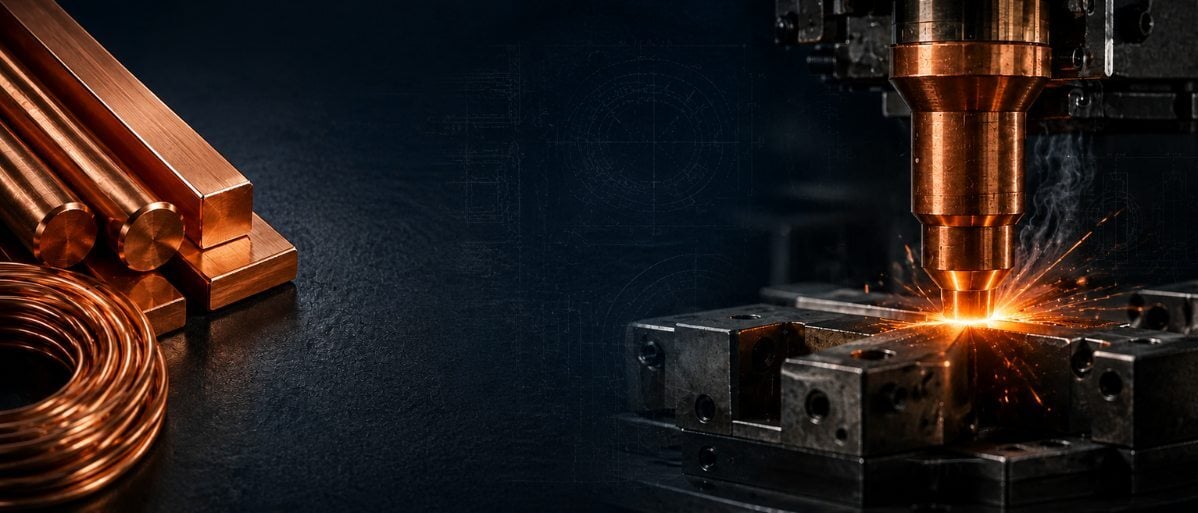
# CuCrZr vs. Pure Copper: When Conductivity Alone Is Not Enough
May 12, 2026, 5:52:25 PM | Written by [Jérémie Dalin](https://academy.ampcometal.com/author/jérémie-dalin)
- [Tweet](https://twitter.com/share)
In most industrial conductivity applications, the first material on the table is pure copper ([C11000](https://alloys.copper.org/alloy/C11000)). It offers the highest electrical conductivity of any commercially available metal, with thermal conductivity to match. For static applications operating near ambient temperature, this is often the right choice.
But many real-world applications are not static, and they are not at ambient temperature. Resistance welding electrodes carry currents that drive tip temperatures past 600°C. Injection molding hot runner nozzles cycle through repeated pressure and thermal loads thousands of times a day. Continuous casting molds run continuously hot. In these environments, pure copper softens, deforms, and loses dimensional integrity.
When that happens, the cost is not the alloy itself. The cost is downtime, scrap, and shortened tool life.
This is the gap CuCrZr was developed to close.
## The mechanical limit of pure copper
Pure copper’s softening behavior is a function of its annealing temperature, which sits around 200 to 250°C. Above that, recovery and recrystallization erase any work hardening introduced during fabrication. Tensile strength drops, hardness falls, and the part begins to deform under loads it could previously sustain.
Specific operating conditions where pure copper falls short:
- Resistance welding electrode tips, where current density and electrode force combine with heat
- Injection molding hot runner nozzles where cyclic thermal and pressure loads during continuous operation can lead to deformation and wear
- High-current contacts and busbars under sustained load
- Continuous casting molds exposed to molten metal contact
- **Solution annealing**, heating the alloy to a temperature where chromium dissolves into the copper matrix.
- **Age hardening**, reheating the alloy to a lower temperature, causing fine chromium precipitates to form throughout the microstructure
In each case, the failure mode is the same: progressive deformation, loss of geometric tolerance, and eventual replacement.
## What changes with CuCrZr
CuCrZr (chromium-zirconium copper, designated CuCr1Zr or C18150) introduces small amounts of chromium (around 0.5 to 1.5%) and zirconium (up to 0.2%) into the copper matrix. Alone, those additions would do little. The transformation comes from heat treatment.
CuCrZr is processed in two stages:
These precipitates are too small to scatter electrons significantly, so most of the copper’s electrical and thermal conductivity is retained. But they are large and distributed enough to pin dislocations under load, which is what gives the alloy its mechanical stability.
The property profile that emerges is something pure copper cannot achieve in any condition:
| **Property** | **Pure Copper (C11000, annealed)** | **CuCrZr (heat-treated)** |
| --- | --- | --- |
| Electrical Conductivity (γ) | ~100% IACS | 75 to 86% IACS |
| Tensile Strength (Rm) | ~220 MPa | 450 to 520 MPa |
| Brinell Hardness (HBW) | ~50 | 140 to 155 |
| Softening onset | ~200°C | ~470 to 500°C |
The trade-off, around 15 to 25% conductivity for roughly double the strength and a much higher softening temperature, is exactly what makes CuCrZr usable in applications where pure copper is not.
## Where the difference shows up in production
### Resistance welding
A pure copper electrode cap mushrooms after a few hundred to a few thousand welds, depending on current and force. CuCrZr caps maintain hardness across far longer runs, which means fewer changeovers, more consistent weld quality, and lower per-weld electrode cost. This is why CuCrZr is the reference material for RWMA Class 2 electrodes.
### Injection molding nozzles
Tool steel offers strength but conducts heat slowly, which extends cycle time. Pure copper conducts well but deforms under load. CuCrZr hot runner nozzles transfer heat efficiently while withstanding cyclic mechanical stress, which can shorten cycle time and improve part surface quality without sacrificing tool life.
### Continuous casting molds
Copper molds need to extract heat from solidifying steel or non-ferrous metals while resisting wear and thermal fatigue at the meniscus. CuCrZr supports stable solidification across long campaigns.
### High-current contacts and busbars
Under sustained load, pure copper components creep and deform. CuCrZr handles the same currents while holding shape, which improves connection reliability and reduces maintenance.
## When pure copper is still the right choice
Not every application needs CuCrZr. If the operating temperature stays below 200°C, mechanical loads are low, and the priority is maximum conductivity, pure copper remains the correct specification. Heat treatment adds cost and process steps, and those are only justified when the operating envelope demands them.
The decision point is straightforward: if the part deforms, mushrooms, creeps, or loses tolerance under operating conditions, CuCrZr is likely the better material. If it does not, pure copper is fine.
## The AMPCO METAL position
AMPCO METAL produces [AMPCOLOY® 972](https://www.ampcometal.com/products/ampcoloy-high-copper-alloy/ampcoloy-972/?utm_source=blog&utm_medium=blog_footer&utm_campaign=cucrzr_organic&utm_term=cucrzr), a chromium-zirconium copper alloy delivered in heat-treated condition with verified mechanical and physical properties. The alloy reaches 86% IACS electrical conductivity, 320 W/m·K thermal conductivity at 20°C, and 520 MPa tensile strength in extruded round bar. It is beryllium-free, RWMA Class 2 classified, and rated for operating temperatures up to 500°C.
For engineers specifying chromium-zirconium copper, the practical question is rarely “should I use CuCrZr.” It is “what form, condition, and supplier will deliver predictable performance.” That is where alloy production discipline, heat treatment control, and machining capability matter as much as the chemistry itself.
[](https://academy.ampcometal.com/hs/cta/wi/redirect?encryptedPayload=AVxigLIrhW6PcpQwOKocPav8H5ovUZMLx62CcW%2Fc%2FN3CxRrA%2Ff8wF7QThxX2Zsrf6zDveswnd60UOFSC6HJfEr4v4UU1vd59ZQWswG2LBG%2FgNOGs%2FSRgl89RJYbLz15wg4fH8FR4BrSj4%2F750S%2FreuztIXbxwUEF86SD8L9Z3OIhpvxghIMso7fMnsJPzTFZ6dHWgoYDp7EYHvnEdShX448O9TlkcfTzAyhR337%2Fdqf6cFjoX3a0%2BESlhYL33hr6wpiJC%2BLfS2VUmJAiceSson3MTAunaSenzEd%2Fk3f7XmE9ddY%2BElRJiUgrbYy067d%2BSCxqGwBho81voSdJ1hvo6%2BClbL6yDw%3D%3D&webInteractiveContentId=212742980024&portalId=5331421&hsLang=en)
-
-
-
-
- [Terms of use](https://www.ampcometal.com/terms-of-use/)
- [Privacy](https://www.ampcometal.com/privacy/)
- [Links](https://www.ampcometal.com/links/)
- [Sitemap](https://www.ampcometal.com/sitemap/)
- [Code of ethics and conduct](https://www.ampcometal.com/documents/CODE-of-ETHICS-and-CONDUCT.pdf)
© 2026 AMPCO METAL